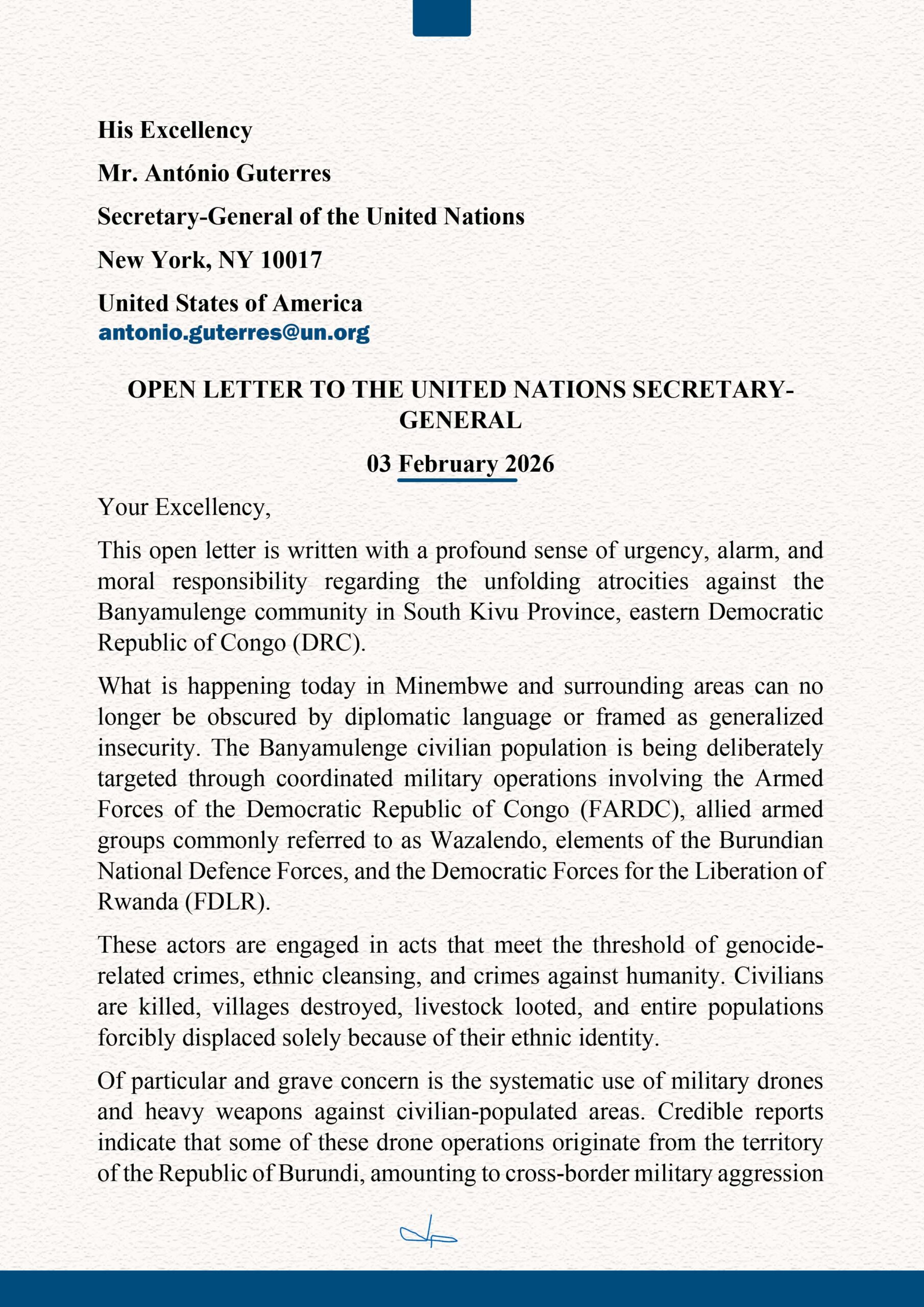




The Banyamulenge community has issued an urgent open letter to United Nations Secretary-General António Guterres, warning of what it describes as ongoing genocide-related crimes, ethnic cleansing, and state-sponsored violence in South Kivu Province, eastern Democratic Republic of Congo (DRC).
In the letter, Jean de Dieu Bizinde, CEO Officer and Ambassador of Peace of the Banyamulenge Community in Australia, accuses multiple armed actors of coordinating attacks against Banyamulenge civilians in Minembwe and surrounding areas. According to the letter, those allegedly involved include the Armed Forces of the Democratic Republic of Congo (FARDC), allied militias commonly known as Wazalendo, elements of the Burundian armed forces, and the Democratic Forces for the Liberation of Rwanda (FDLR).
“The violence unfolding on the ground can no longer be framed as generalized insecurity,” the letter states, arguing that civilians are being targeted specifically because of their ethnic identity. Entire villages have reportedly been destroyed, livestock looted, and thousands of civilians forced to flee their homes.
Drone warfare and cross-border allegations
A central concern raised in the open letter is the alleged use of military drones and heavy weapons against civilian-populated areas. The Banyamulenge leadership claims that such attacks represent a dangerous escalation in the conflict and amount to collective punishment of a civilian population.
The letter further alleges that some drone operations originate from neighboring Burundi, a claim that, if substantiated, would point to cross-border military involvement and serious violations of international humanitarian law. The accusations call for an independent international investigation to establish responsibility and verify the chain of command behind the attacks.
Calls for accountability and international action
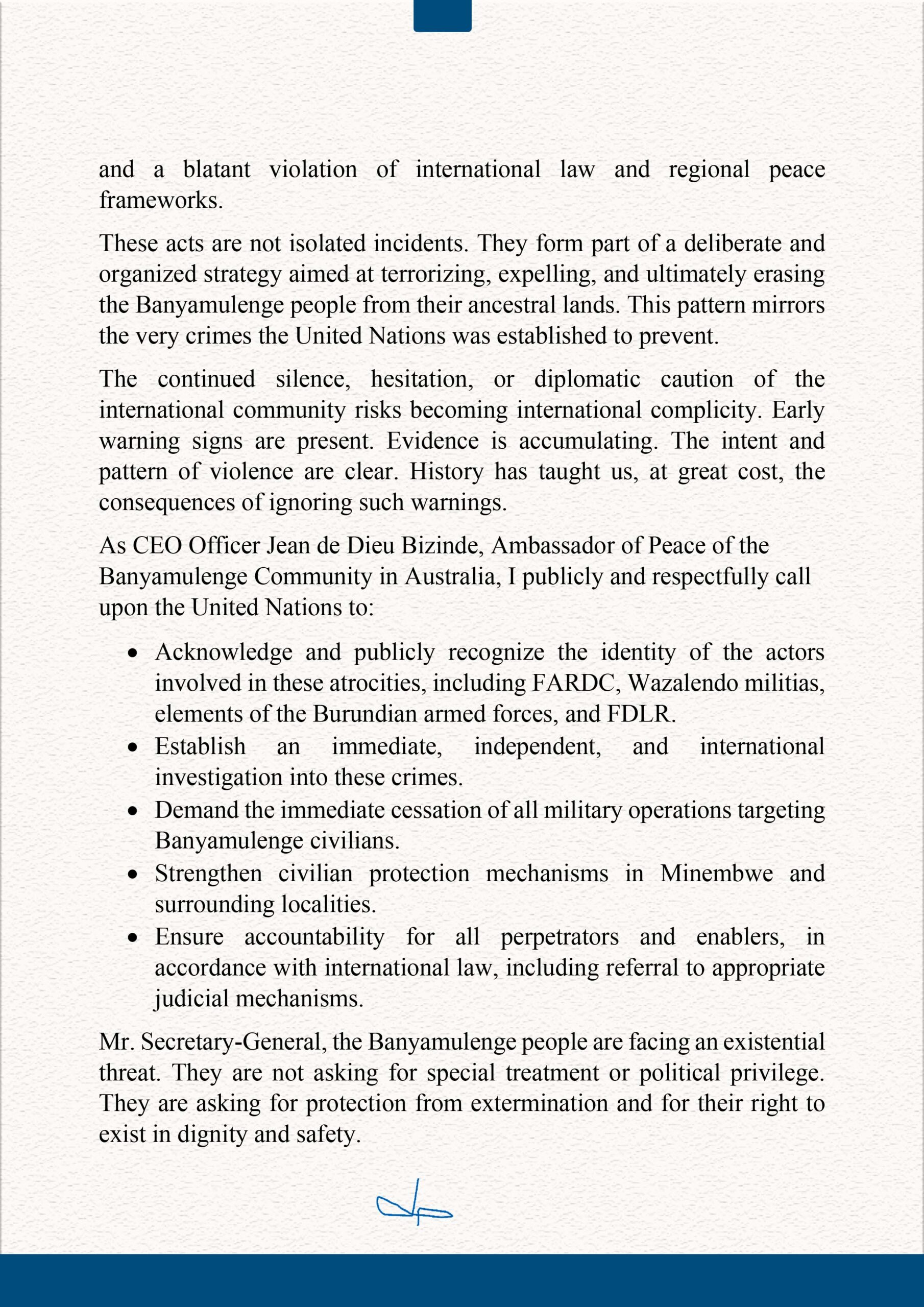
The Banyamulenge community argues that the pattern, scale, and consistency of the violence meet internationally recognized thresholds for crimes against humanity and genocide-related acts. The letter warns that continued inaction by the international community risks entrenching impunity and creating what it describes as “international complicity through silence.”
Among the demands addressed to the United Nations are an immediate halt to military operations targeting civilians, the deployment of stronger civilian protection mechanisms in Minembwe and surrounding localities, and the initiation of an independent fact-finding mission. The letter also calls for accountability measures, including possible referrals to international judicial mechanisms.
Broader diplomatic outreach
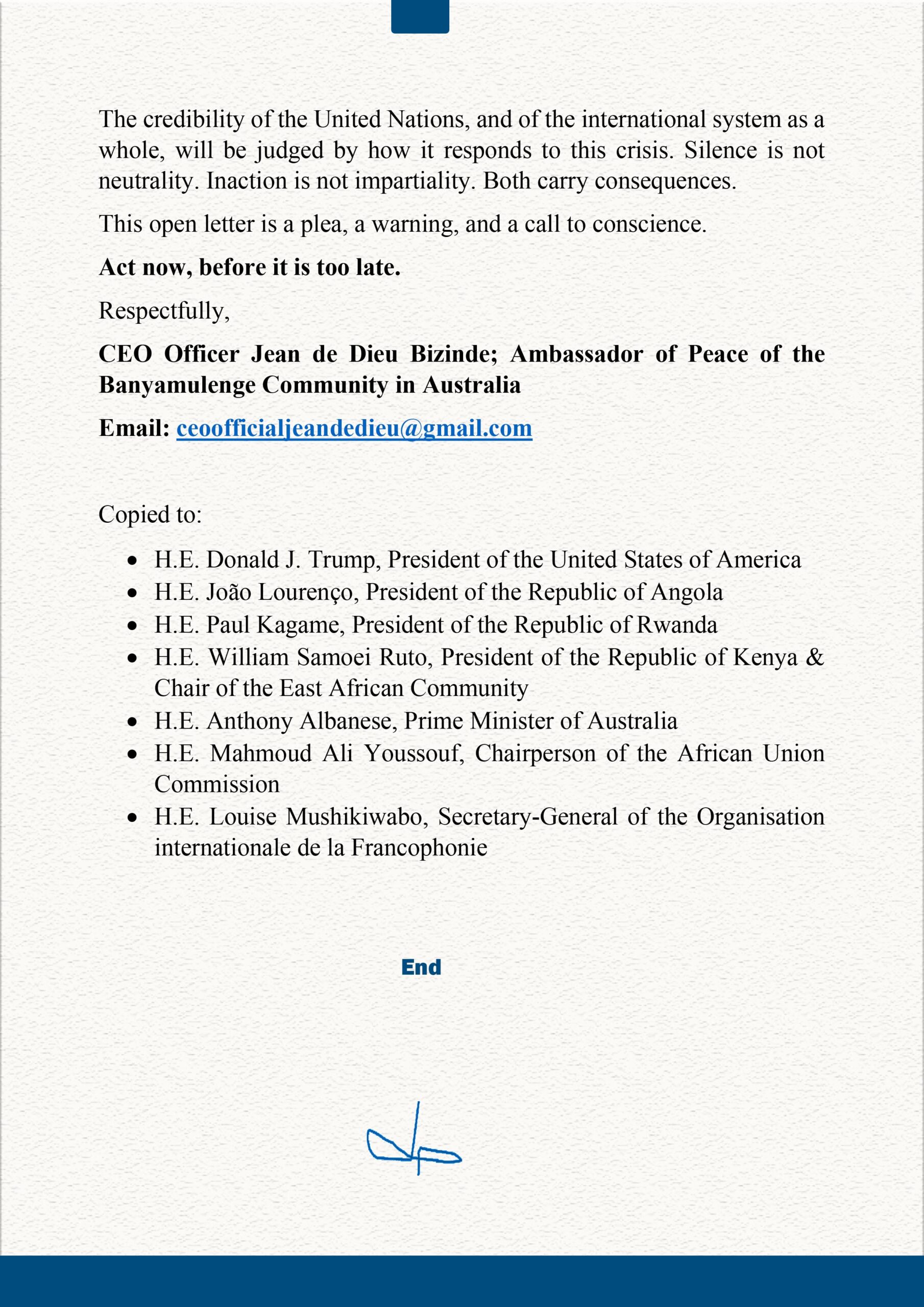
Copies of the open letter were sent to several international and regional leaders, including the President of the United States, the Chair of the African Union, the President of Angola, the President of Rwanda, the President of Burundi, the Chair of the East African Community, the Prime Minister of Australia, and the Secretary-General of the Organisation internationale de la Francophonie.
“The Banyamulenge people are facing an existential threat,” Bizinde wrote. “They are not asking for political privilege, but for protection from extermination and the right to exist in dignity and safety.”
A test for international institutions
The letter concludes with a warning that the credibility of the United Nations and the broader international system will be judged by how it responds to the crisis in South Kivu. “Silence is not neutrality,” it says, urging decisive action to prevent further loss of civilian life.
As violence continues in eastern Congo, the appeal adds to growing calls from civil society groups and affected communities for stronger international engagement to protect civilians and address long-standing cycles of violence in the region.