




Alireza Aarafi has been elected by Iran’s Assembly of Experts to serve on the interim leadership council of the Islamic Republic, following constitutional provisions governing succession at the highest level of authority. His appointment places him among the three clerical figures entrusted with temporarily assuming the responsibilities of national leadership until a new Supreme Leader is formally selected.
The announcement was made by the spokesperson of the Assembly of Experts, though official details regarding the internal deliberations of the meeting were not disclosed. Under Article 111 of Iran’s Constitution, in the event of the death of the Supreme Leader, a provisional council assumes leadership duties until the Assembly of Experts appoints a successor. This council does not exercise full sovereign authority; its decisions require substantial approval within the Assembly to take effect.
Serivisi za Digital za Afrovera
Dufasha business n’imishinga kugaragara online bin yuze muri serivisi za digital zinoze kandi ku giciro gito cyane.
- ✔ Gukora Website za business & companies
- ✔ Posters & Graphic Design
- ✔ Website Hosting & Domain
- ✔ Gufungura YouTube Channels za business
The transition unfolds amid heightened political sensitivity and intense scrutiny over succession scenarios. International outlets, including The New York Times, have reported on possible frameworks for leadership continuity, while Iranian state-aligned media have dismissed such coverage as speculative. Senior military figures have publicly emphasized institutional stability, asserting that strategic command structures remain intact. In previous statements, Ali Khamenei had outlined clear chains of responsibility within the armed forces, reinforcing the perception that the system is designed to function even during periods of leadership transition.
Born in 1955 in Meybod, Yazd Province, Aarafi comes from a prominent clerical family. His father, Mohammad Ebrahim Aarafi, was known for opposing the Pahlavi monarchy and maintaining connections with influential religious figures. Aarafi began his religious education early, studying Qur’anic sciences and Islamic jurisprudence before relocating to Qom, the country’s principal center of Shiite theological scholarship. There, he pursued advanced seminary training under several distinguished scholars and later expanded his academic engagement into philosophy and contemporary Islamic thought.
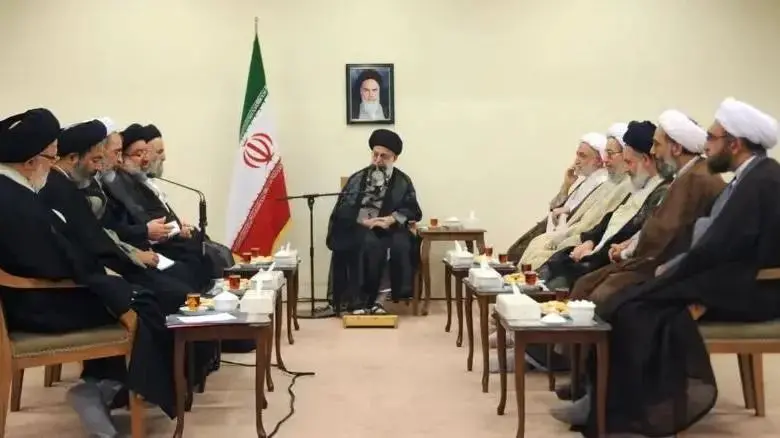
Over the decades, Aarafi has built a substantial institutional profile. He has served as a professor in both seminaries and major universities, supervised numerous scholarly projects, and contributed to shaping theological education nationwide. In 2002, he was appointed head of the International Center for Islamic Sciences by decree of Ali Khamenei, a move widely interpreted as a sign of growing confidence in his leadership capabilities. He later assumed the position of head of the Qom Seminary and became a member of Iran’s Supreme Council of the Cultural Revolution, further consolidating his influence within the country’s religious and policy-making structures.
Aarafi has also played an active political role. He secured a seat in the Assembly of Experts representing Tehran Province and has been involved in shaping religious and cultural policy at the national level. His public statements over the years have aligned closely with the official ideological orientation of the Islamic Republic, particularly on issues of foreign policy and internal governance. His clerical title evolved from Hujjat al-Islam to Ayatollah, reflecting his ascent within the religious hierarchy.
Until recently, Aarafi maintained a relatively modest public profile compared to other senior clerics. However, his steady institutional advancement and proximity to the Supreme Leader have elevated his standing within Iran’s power structure. As generational shifts continue within the Islamic Republic’s leadership, his appointment to the interim council underscores both his accumulated authority and the trust placed in him by the country’s highest governing bodies. Observers now regard him as a consequential figure in Iran’s transitional moment, with potential implications for the future configuration of political and religious leadership.