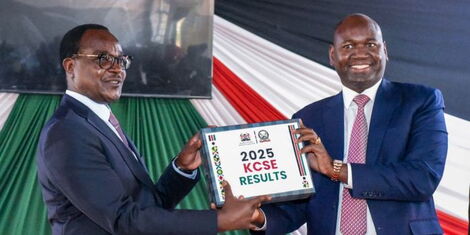




The Kenya National Examinations Council (KNEC) has officially released the 2025 Kenya Certificate of Secondary Education (KCSE) results, marking one of the most watched education moments in the country. The announcement was made by Education Cabinet Secretary Julius Ogamba at AIC Chebisaas High School in Eldoret, Uasin Gishu County.
This year’s results come at a time when thousands of learners, parents, and schools were eager to understand how performance has shifted and what it means for university placement and future careers. The 2025 KCSE results paint a picture of steady improvement, rising competition, and changing trends across age, gender, and school categories.
A total of 993,000 candidates sat for the 2025 KCSE examination. This large number shows how important the national exam remains in shaping access to higher education in Kenya. For many learners, KCSE is still the main bridge to universities, colleges, and professional training.
Out of all the candidates who sat the exam, 492,019 were boys while 501,214 were girls. This confirms that female candidates slightly outnumbered their male counterparts in the 2025 cohort. Together, they sat examinations in 30 different subjects, administered through 74 separate examination papers.
One of the most important highlights of the 2025 KCSE results is the number of students who qualified for direct university admission. A total of 270,715 candidates scored a mean grade of C+ and above. This represents 27.18 per cent of all candidates who sat the examination.
Female candidates accounted for roughly 50 per cent of the entire examination cohort, showing near gender balance at the national level. This balance continues to shape discussions around access, performance, and equity in education.
Top performance also saw a notable rise. A total of 1,932 candidates achieved grade A, making them the highest-performing group in the country. This number marks an increase in top achievers compared to previous years and signals improving academic outcomes at the highest level.
School performance trends reveal interesting patterns. Candidates who attained grade C- and above stood at 507,131, representing 50.92 per cent. This is an improvement from 476,889 candidates, or 49.41 per cent, recorded in 2024.
Those who scored grade D+ and above totalled 634,082 candidates, accounting for 63.67 per cent of the total candidature. This is also an improvement from 2024, when 605,774 candidates, or 62.76 per cent, reached the same level.
National schools continued to dominate top performance. They produced 1,526 candidates with an overall mean grade of A. Extra County schools followed with 197 candidates, while Private schools produced 185 candidates with grade A results.
When it comes to direct university entry, Sub-County schools recorded a surprising outcome. They outperformed County schools, with 72,699 candidates achieving C+ and above, compared to 36,600 candidates from County schools. This result has sparked fresh debate on resource use and teaching quality across school categories.
The Ministry of Education also addressed the issue of examination integrity. A total of 1,180 candidates were implicated in examination irregularities, and their results were cancelled. Authorities emphasized that exam credibility remains a top priority.
Age analysis of the 2025 KCSE candidates revealed a rising number of younger learners. Candidates aged 16 years and below increased from 20,546 in 2024, representing 2.13 per cent, to 26,391 in 2025, accounting for 2.65 per cent.
Despite this increase, most candidates were within the expected age range. Learners aged between 17 and 19 years formed the largest group, with 716,048 candidates. This group represented 72.02 per cent of the total candidature.
Subject performance showed mixed outcomes across the curriculum. KNEC reported that 17 subjects recorded a significant improvement in performance in 2025. This number is the same as in 2024, showing steady subject-level progress.
At the same time, performance declined in 11 subjects in 2025. This is a slight increase compared to 10 subjects that recorded a decline in the previous year, indicating areas that may need targeted intervention.
Gender analysis revealed clear differences in subject performance. Female candidates outperformed male candidates in six subjects, including English, Kiswahili, Kenyan Sign Language, Home Science, Christian Religious Education, and Art and Design.
Male candidates recorded higher mean scores in 11 subjects. These included Mathematics Alternatives A and B, Biology, Chemistry, History and Government, Geography, Islamic Religious Education, Building Construction, and Business Studies.
Performance between male and female candidates was almost equal in seven subjects. These included Physics, Agriculture, Computer Studies, and Music, showing balanced engagement and achievement in these areas.
KNEC noted that in some technical subjects, such as Metalwork, Power Mechanics, Electricity, Drawing and Design, and Aviation Technology, the number of female candidates was too small to allow for meaningful comparison. This highlights ongoing gender gaps in technical and vocational subject choices.
Following the official release of the results, candidates can now check their 2025 KCSE results online through the official KNEC portal at results.knec.ac.ke. Candidates are required to enter their index number exactly as provided during registration.
In a major policy shift, the Ministry of Education also announced a new system for KCSE certificate collection. Candidates will now collect their certificates from sub-county education offices instead of their former schools.
This change is meant to address long-standing issues of withheld certificates, especially cases linked to unpaid school fees. The ministry says the move will ensure fairness and timely access to academic documents.
Overall, the 2025 KCSE results reflect gradual improvement, stronger top performance, and evolving trends in age, gender, and school categories. As Kenya looks ahead to university placements and education reforms, these results will play a key role in shaping the future of learning in the country.