Home Blog Page 60

Renowned Gospel Singer to Be Laid to Rest Today as Custody Concerns Draw Public Attention

0

The body of the celebrated gospel singer, whose music touched countless hearts across the country, is set to be laid to rest today on a parcel of land she purchased prior to her passing. The burial marks the final chapter of a life that inspired many within the gospel industry and beyond.

Mourners began gathering early this morning at the Kenyatta University Teaching, Referral & Research Hospital Funeral Home, where family members, friends, fellow artists, and members of the clergy lined up for the final viewing. Among those present was her ex-husband, Pastor Victor Kanyari, who arrived alongside close relatives to pay his last respects. Her current husband, popularly known as Tash, is also in attendance, standing with the family during this emotionally heavy moment.

The funeral is expected to draw significant public attention, not only because of the singerโ€™s influence in the gospel community, but also due to growing interest surrounding the future custody and welfare of her two young children. Public discussions have emerged on who between Pastor Kanyari and Tash, will assume full responsibility for the minors, given the sensitive dynamics of blended families and the sudden loss that has befallen them.

Family members have urged the public to remain respectful and considerate during this difficult period, noting that decisions concerning the children will be guided by the law and the best interests of the minors.

Emotions are expected to run high during the burial, particularly given the tender ages of the children left behind and the profound loss felt across the gospel fraternity. Close friends have described the late singer as a devoted mother and a resilient woman whose life, though cut short, leaves behind a powerful legacy of faith and artistry.

The burial ceremony will proceed later in the afternoon, where religious leaders are expected to lead prayers and tributes in honor of her impactful life.

What Kenyans Should Expect From President Rutoโ€™s 2025 State of the Nation Address

0

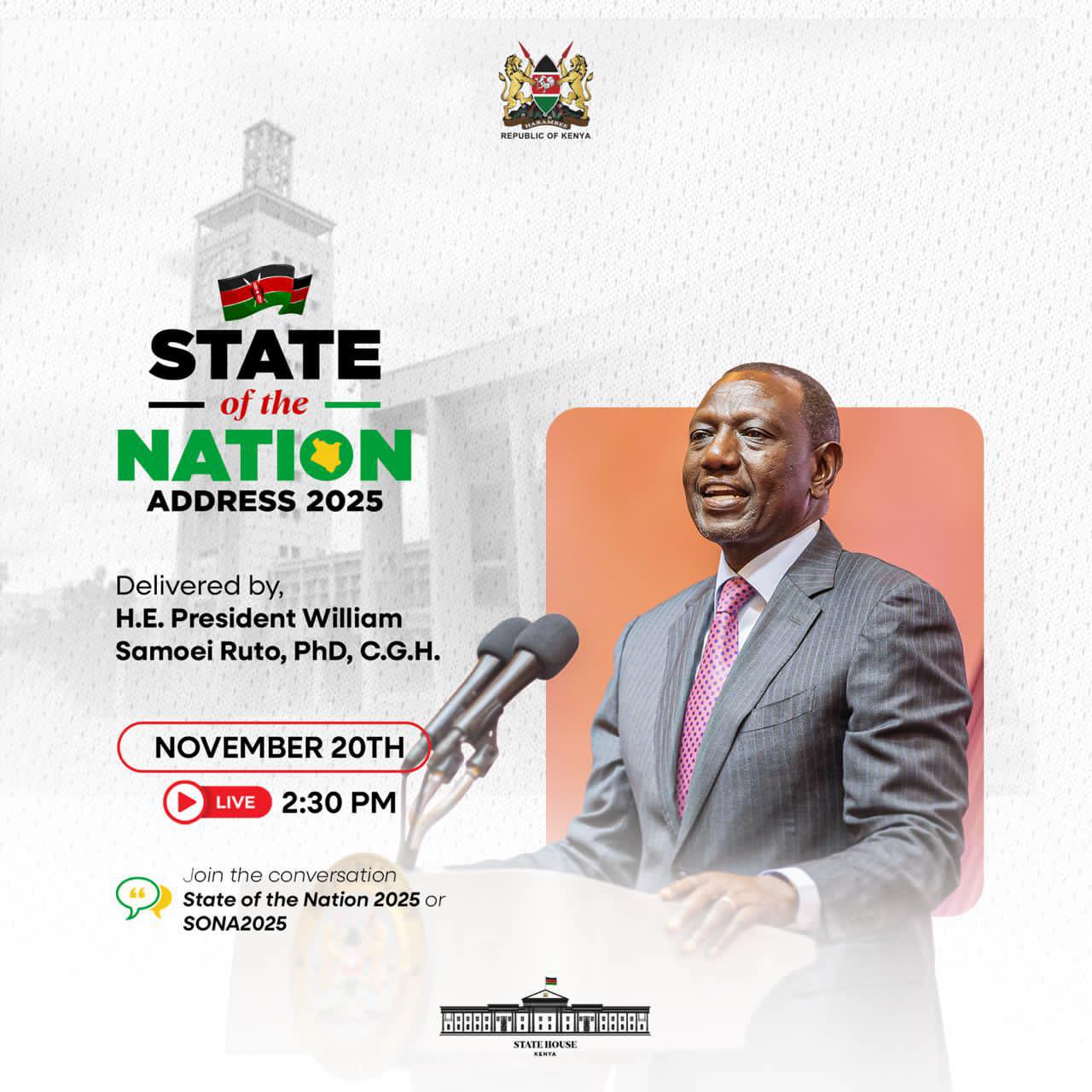
Kenya heads into the 2025 State of the Nation Address at a moment of heightened political expectation, economic pressure, and public scrutiny. As President William Samoei Ruto prepares to address the nation on November 20th at 2:30 p.m., Kenyans are looking for more than a constitutional ritual they want clarity, reassurance, decisive direction, and measurable results.

Many citizens expect the president to speak directly to the rising cost of living, unemployment, food security challenges, and the state of the economy following months of inflation and currency volatility. For millions facing high food prices, tough loan conditions, reduced household income and increased taxation, the question remains what concrete measures the government will lay out to stabilize the economy and cushion families already stretched thin.

A significant portion of the public will also be waiting for updates on the governmentโ€™s flagship policy, the Bottom-Up Economic Transformation Agenda (BETA). The expectation is that the president will outline what has worked, what has stalled, and what his administration intends to adjust in the coming year. Farmers, traders, boda boda operators, MSMEs, and unemployed youth will be looking for renewed commitments and verifiable proof that the economic agenda is still on track.

Security remains a major concern, especially with recent criminal activities in major towns, increased cases of armed robberies, and ongoing operations against banditry in the North Rift. Kenyans anticipate a strong statement on national security reforms, police welfare, intelligence capacity, and community safety. With security agencies already tightening measures across Nairobi ahead of the address, the public expects assurances that these preparations reflect a sustained commitment rather than a one-day display.

Many will be following closely for updates on corruption and governance. Public perception remains divided, with growing pressure on the administration to demonstrate stronger action against graft affecting ministries, counties, and state corporations. Civil society groups and watchdog institutions expect the president to recommit to transparency while offering tangible steps to restore public trust.

On foreign policy, Kenyans anticipate firm clarity on Kenyaโ€™s expanding role in regional and global affairs from peacekeeping missions to diplomatic involvement in East African and Great Lakes regional crises. With the Haiti deployment, Sudan conflict, DRC crisis, and shifts in EAC politics, Ruto is expected to frame Kenya as a stabilizing actor and explain how these engagements align with the countryโ€™s long-term interests and security.

The political climate also makes this address particularly significant. With succession debates slowly emerging ahead of 2027, Kenyans want an assurance that national priorities not political realignments will remain at the center of government decisions. Calls for unity, inclusion, and less political polarization are expected to feature prominently in the national conversation.

The president is also likely to highlight government achievements in infrastructure, technology, digital economy reforms, education, and health. However, what citizens will be evaluating most is whether these achievements have translated into improvements in their personal lives. The gap between policy announcements and lived realities is an issue Kenyans increasingly demand leaders to address honestly.

As the president makes his 13th State of the Nation Address, the mood in Nairobi and across the country is one of cautious anticipation. Kenyans do not merely want to hear promises they want timelines, accountability, and measurable progress. They want reassurance during an economically tough period, a roadmap for growth, and clarity on what the government will do differently in 2026.

The address represents a defining moment for the administration to reconnect with the public, shape national expectations, and set the tone for the coming year. Whether the speech will meet the weight of public expectation remains the question many will be asking as the nation tunes in.

President Ruto Wins CAF Outstanding Achievement Award for Transforming African Football

0

President William Ruto has received the CAF Presidentโ€™s Outstanding Achievement Award, a distinguished honour recognising his notable contribution to the advancement and promotion of football across Africa.

The accolade comes in the wake of a widely followed football event at Kasarani Stadium, where Kenyaโ€™s growing influence in the regional football landscape was on full display. The match marked yet another milestone in the countryโ€™s efforts to elevate its football profile.

CAF commended President Ruto for his leadership in driving sports development, citing his commitment to modernising infrastructure, expanding youth talent programmes, and encouraging greater investment in the game. According to the organisation, these initiatives have played a crucial role in strengthening football structures both locally and regionally.

The continental football body further noted that Rutoโ€™s vision has helped position Kenya as an emerging host for major African tournaments, reinforcing the nationโ€™s bid to become a central hub for elite football in the years ahead.

DR Congo Raises Military Budget to 20% in 2026 Plan as War With M23 Escalates

0

The Democratic Republic of Congo has allocated 20 percent of its new national budget to the military, a significant increase aimed at โ€œreclaiming every inch of national territory seized by the enemy,โ€ Prime Minister Judith Suminwa told Parliament on Tuesday.

Presenting the 2026 draft budget before the National Assembly, Suminwa announced a spending plan of 59 trillion Congolese francsโ€”equivalent to more than US$20 billion. Nearly 12 trillion francs will be directed to strengthening the army, police, and security services.

The allocation marks a major jump from last year, when military, security, and justice combined accounted for 13 percent of the national budget. This yearโ€™s spending prioritizes the armed forces alone.

โ€œIn accordance with the vision of the Commander-in-Chief of our national army, the government is fully committed to recovering every part of our territory that has fallen into enemy hands,โ€ Suminwa said in her address to MPs.

Kinshasa is currently engaged in a conflict with the AFC/M23 movement, which claims to control more than 34,000 square kilometers across North and South Kivuโ€”territory it says is home to over 10 million civilians, including the key cities of Bukavu and Goma.

Both sides are participating in ongoing talks in Doha, Qatar, where regional and international mediators are attempting to secure a framework for peace and a ceasefire.

The budget increase follows the governmentโ€™s broader defense plan expected to run through 2028, focusing on modernizing the military, improving troop welfare, reinforcing logistics, and upgrading military infrastructure.

Despite these plans, fighting continues in several parts of eastern DRC, where the national army, backed by the Wazalendo militia coalition, battles M23 fighters across shifting frontlines.

Kinshasa accuses Rwanda of providing military support to M23, allegations Kigali has repeatedly denied. Rwanda, in turn, accuses the Congolese army of collaborating with the FDLR, a militia with roots in those responsible for the 1994 Genocide against the Tutsi. The DRC government rejects this claim as well.

Beyond defense, Suminwa highlighted four additional priority sectors and their allocations under the new budget:

  • Economic development, infrastructure, agriculture, energy, and industry ย โ€“ 11 trillion Congolese francs
  • Education ย โ€“ 6 trillion francs
  • Health , including universal health coverage, maternal care, and disease prevention โ€“ 5.5 trillion francs
  • Social welfare , including pensions and support for displaced populations, especially in the east โ€“ 1.2 trillion francs

According to the government, these investments are meant to stabilize the country, address urgent humanitarian needs, and build long-term resilience amid one of the regionโ€™s most complex and protracted conflicts.


Nairobi Locks Down as President Ruto Prepares for a Defining 2025 State of the Nation Address

0

Security agencies in Nairobi have intensified operations across the capital ahead of President William Rutoโ€™s annual State of the Nation Address, scheduled to take place in Parliament on Thursday, November 20, 2025, at 2:30 p.m. Officials described the heightened presence as routine preparations to ensure safety and maintain order as the country gears up for one of its most consequential constitutional moments.

Teams of officers have been deployed to conduct spot checks, increase patrols, and disrupt any emerging criminal activity, particularly within the city centre. Other units carried out rehearsals around Parliament as part of the final logistical preparations. Police have announced that several roads surrounding the precincts of Parliament will be temporarily closed to traffic, advising motorists to seek alternative routes to avoid disruptions.

Nairobi police commander George Seda said more personnel had been mobilized to keep the city secure, noting that patrols would be expanded even further as the festive season approaches.

President Ruto is expected to deliver what will be the 13th State of the Nation Address, a constitutionally mandated appearance under Article 132(1)(b), which requires the Head of State to address a joint sitting of the National Assembly and Senate at least once every year. Speaker Moses Wetangโ€™ula formally notified legislators after receiving the official communication from the Presidentโ€™s office.

The address will serve as a key moment for Rutoโ€™s administration, offering an opportunity to take stock of the countryโ€™s progress, outline policy priorities, and reaffirm Kenyaโ€™s political and economic direction. He is expected to highlight the governmentโ€™s performance over the past year, focusing on areas such as economic transformation, national unity, security, and infrastructureโ€”priorities that have shaped his administrationโ€™s agenda.

Ruto is also obliged to submit a report to Parliament on Kenyaโ€™s progress in fulfilling its international obligations. This yearโ€™s address comes amid persistent regional tensions, cross-border human rights concerns, and growing domestic political polarization.

The government has recently introduced several significant policy and financial reforms, including the establishment of a sovereign wealth fund and a dedicated infrastructure fund aimed at improving the management of public debt. These initiatives, while welcomed by some, have drawn skepticism from sections of the political class, with some lawmakers signaling potential dissent ahead of the parliamentary debate that will follow the address.

The timing carries additional political weight. Having been in office for more than three years, Ruto is approaching the decisive second half of his term. Observers say the speech may be used to frame his vision for the remainder of his presidency, especially as the 2027 election cycle gradually takes shape. With the passing of former Prime Minister Raila Odingaโ€”who had previously expressed willingness to work with the Presidentโ€”the political landscape has shifted significantly, adding new dimensions to the national debate.

After the address, Parliament will open discussions on its contents. The reactions from lawmakers will offer important signals about emerging alliances, potential pushback, and the broader mood of the country as Kenya evaluates the Presidentโ€™s message and the road ahead.

Rwanda Ends Its Seven-Year Visit Rwanda Partnership With Arsenal FC

0

The government of Rwanda has officially concluded its seven-year partnership with Arsenal FC, marking the end of one of the most visible tourism-promotion deals in global sports. In a statement released by the Rwanda Development Board (RDB), the institution confirmed that both parties โ€œmutually agreed to conclude their partnership at the end of the current season,โ€ which ends in June 2026.

Arsenal also issued a statement acknowledging the end of the agreement with what it described as its โ€œfirst official sleeve partner,โ€ a deal under which the Visit Rwanda logo has appeared on the clubโ€™s shirt sleeve and promotional assets since 2018. The initial three-year agreement was renewed in 2021 and was approaching its natural conclusion, but Rwanda opted not to extend it.

According to Arsenalโ€™s 2023โ€“2024 financial report, the club received $13.4 million per year ย roughly Rwf 20 billion ย under the sponsorship arrangement. The partnership was among the most discussed global sports marketing deals involving an African nation, drawing both praise and criticism throughout its duration.

In recent weeks, reports suggested that discussions were underway to determine whether the agreement would be renewed. RDBโ€™s announcement indicates that Rwanda is shifting its tourism-promotion strategy toward โ€œnew and emerging marketsโ€ as part of its next growth phase. According to the agency, the partnership has supported Rwandaโ€™s tourism visibility, contributing to 1.3 million visitors recorded last year.

RDB further notes that since the launch of the Visit Rwanda campaign with Arsenal, tourism revenue has grown by 47 percent, reaching $650 million ย a figure it attributes partly to increased exposure through sports partnerships.

Despite the commercial success, the deal has not been without controversy. A section of Arsenal supporters had recently called on the clubโ€™s board not to renew the agreement, accusing the Rwandan government of supporting the M23 movement in eastern Democratic Republic of Congo ย allegations the government of Rwanda strongly denies. Kigali maintains that it has no role in the conflict and insists that its actions in the region are limited to national security concerns.

The chief executive of RDB, Jean-Guy Afrika, praised the achievements of the collaboration, describing the partnership as a โ€œsource of prideโ€ that delivered significant global visibility for the country. Arsenalโ€™s chief executive Richard Garlick echoed this sentiment, saying the club was proud to have helped Rwanda amplify its tourism brand on the international stage.

President Paul Kagame, an outspoken Arsenal supporter, has been one of the most recognizable public figures associated with the club during the partnership, often commenting on team performance on social media and publicly supporting the campaign.

Beyond Arsenal, Rwanda continues to invest heavily in global sports marketing. Visit Rwanda maintains similar partnerships with Paris Saint-Germain in France and Atlรฉtico de Madrid in Spain. More recently, RDB signed deals with the LA Clippers of the NBA and the Los Angeles Rams of the NFL, expanding the brandโ€™s visibility to the North American market.

The conclusion of the Arsenal partnership marks a significant strategic shift as Rwanda reassesses how to position itself in the next phase of global tourism promotion, balancing its brand visibility with evolving priorities and emerging markets.

Women betrayed in Lamu Police recruitment, why were they shut out after 4 years of waiting

0

For dozens of young women in Lamu, the long-awaited dream of joining the National Police Service turned into a devastating ordeal this week after they were abruptly informed that no recruitment slots had been allocated for women in the county. Many of them had waited nearly four years for the next national intake, only to walk away heartbroken, confused, and demanding answers.

Witnesses say the women began arriving at the recruitment grounds before sunrise, some traveling from remote islands and mainland villages across Lamu County. Many had spent months preparing: running daily, improving their health, saving money for transport and medical forms, and gathering every required document.

But their excitement turned into disbelief when recruitment officials allegedly announced that only male candidates would be considered.

โ€œWhen they told us women were not needed, it felt like a slap in the face,โ€ said one aspiring recruit. โ€œWe have waited, trained, and sacrificed. How can they exclude us like this?โ€

Others described how they stood silently as male candidates were processed, leaving them unsure whether to protest, demand clarification, or simply walk away. Several women broke down in tears, saying they had pinned their hopes on this career path after years of unemployment and limited opportunities in the region.

The incident has triggered public outrage, with community leaders, local activists, and gender rights groups condemning the exclusion as blatant discrimination. Many argue that Lamu, an area repeatedly affected by insecurity, unemployment, and the need for inclusive policing, cannot afford to shut out qualified women.

Human rights defenders have labelled the event a violation of constitutional principles on gender equality and fair access to public service. Some have warned that such actions undermine public confidence in national recruitment processes, especially in historically marginalized areas.

The concerns reached the National Police Service headquarters, prompting a response from Police Spokesperson Nyaga, who confirmed that the service is now investigating the matter.

โ€œWe are looking into what happened in Lamu,โ€ he said. โ€œThe National Police Service is committed to equal opportunity and gender balance in all recruitment exercises. If any irregularities occurred, the necessary corrective measures will be taken.โ€

Nyaga did not disclose details on whether the exclusion was a local decision, a logistical mix-up, or a misunderstanding, but insisted that the service does not support discrimination in any form.

For many, this is not the first-time women in coastal regions have expressed frustration over being sidelined in recruitment into security agencies. Advocates note that women often face additional barriers including:

Limited access to training and preparation facilities Cultural and social stereotypes regarding โ€œsuitable roles “Fewerย recruitment slots in remote countiesInconsistent communication from authorities

This latest incident, they say, reinforces a wider systemic issue that must be addressed if Kenya is to achieve meaningful gender representation in its security institutions.

Despite the disappointment, several women said they have not lost hope. Many are calling for a repeat recruitment exercise or an official clarification from the National Police Service confirming whether women in Lamu will get another chance.

โ€œI still want to serve my country,โ€ said one applicant. โ€œBut we need fairness. We need transparency. And we need to know that our efforts matter.โ€

As investigations proceed, the spotlight is now firmly on the National Police Service to explain why women in Lamu were turned away and to ensure corrective action is taken. Gender equality advocates are urging authorities to audit all recruitment centers to prevent similar incidents in other counties.

For now, the affected women remain united in their demand for one thing: aย fair opportunity to serve in the uniform they have worked years to earn.

Bobi Wineโ€™s Path to Victory: How Ground Game and Vote Protection Could Flip Uganda

0

Bobi Wineโ€™s path to State House is possible but narrow, hinging less on the drama of rallies and more on a hard, technical grind: agent coverage at nearly every polling station, disciplined rural organizing, and a message that stays welded to livelihoods. His natural base remains the metropolitan belt Kampala, Wakiso, Mukono where a young, connected electorate is most receptive to a change narrative built on jobs, prices, and accountability. To turn enthusiasm into power, the urban vote must both swell in turnout and export its momentum to secondary towns such as Gulu, Mbarara, Arua, Mbale, Masaka, and Jinja, where close-run constituencies can tilt the national tally.

The demographic wind is at his back. Ugandaโ€™s youthful population feels the bite of unemployment and a high cost of living; many first-time voters respond to plain language about SMEs, skilling, and easing the path from school to work. When Bobi Wine keeps the conversation fixed on these bread-and-butter issues, he pulls in undecideds and soft critics who are tired of political heat but crave practical relief. The danger is message drift. If confrontation eclipses livelihoods, swing voters retreat to the comfort of continuity and the promise of order.

Rural Uganda remains the decisive arena. The ruling partyโ€™s village-level organization, honed over decades, is formidable. Bobi Wine cannot match it with spectacle; he must counter it with small organizers who know their neighbors by name. The winning unit is not the rally but the five-person cell in each sub-county: a church youth leader, a SACCO mobilizer, a boda-boda chair, two women leaders. Their job is not to argue ideology but to prepare turnout lists, arrange election-day transport, and solve petty obstacles childcare during queues, drinking water at the station, a shared umbrella when the rain comes. When politics is reduced to logistics, a thin organization becomes a thick presence.

Everything depends on protecting the vote. Results are born at the station and die in paperwork. Bobi Wineโ€™s campaign needs trained, credentialed agents power banks, data bundles, and a legal hotline for virtually every polling place. Each agent should photograph the original declaration form, upload it to a secure repository, and log chain-of-custody details. Parallel tabulation must be quiet, lawful, and documented, ready to reconcile with district tallies. Where discrepancies appear, the campaignโ€™s first instinct should be to cite station IDs, times, and form numbers, not adjectives. Courts do not award outcomes to emotions; they respond to evidence.

Radio beats social media beyond the city limits. Vernacular stations still set the dayโ€™s conversation in market towns and villages. Short, repeated explainers how to mark a ballot, why spoiled votes matter, where to find the right queue move more numbers than an elegant manifesto PDF. Women and first-time voters deserve tailored pledges: reliable maternity and primary healthcare, lower school-related fees, internships or skills vouchers aligned to local trades. The promise is modest but tangible: small businesses that can breathe; clinics that work; roads that last.

Alliances matter, even if they are quiet. In districts where opposition heavyweights from other parties hold sway, non-aggression pacts prevent reform votes from cannibalizing one another. Sharing venues, swapping surrogate speakers, or pooling agents at select stations can squeeze out two or three percentage points the difference between a symbolic showing and a credible national challenge. Transparency in fundraising and spending helps inoculate against attacks about hidden backers and sustains volunteers who sacrifice time and money in the final stretch.

Election day is a stress test of discipline. The campaign that de-escalates incidents at queues, documents problems without inflaming them, and keeps supporters focused on voting rather than arguing will retain the moral high ground and the practical advantage. After the count, the tone matters as much as the tally. A call for calm, a presentation of documents, and respect for legal timelines do not signal weakness; they build legitimacy with the silent middle that ultimately decides whether a victory is accepted or a dispute is heard fairly.

Numerically, Bobi Wineโ€™s route requires urban blowouts approaching 70โ€“80 percent in the capital region, competitive margins in peri-urban districts, and credible inroads in selected rural counties where economic frustrations run deepest. Just as crucial is turnout symmetry: if city turnout narrows the historic gap with rural areas and spoilage stays low thanks to voter education, the national math tightens quickly. Conversely, a few thousand uncovered stations or poorly briefed agents can erase the advantage earned by months of mobilization.

Time is short but sufficient if used with precision. The campaign window closes two days before polls, leaving a handful of weeks for three sprints: training and deploying agents, saturating vernacular radio with practical voter information, and seeding pocket organizers across rural sub-counties. Every shilling spent should answer one question will this add verified votes at a specific station? Billboards donโ€™t; transport stipends, power banks, and paralegal support often do.

If Bobi Wine wins, the story will not be about the biggest crowd but the smallest form: a clean declaration sheet photographed under poor station light, uploaded through a shaky signal, and matched line-for-line at the tally center. If he falls short, the architecture he builds now local organizers, lawful evidence habits, and a reputation for calm becomes the scaffold for the next contest and a lever in parliament and city halls. Either way, a campaign that treats citizens as partners, not props, will have moved Ugandan politics closer to service and accountability.

Tanzania arrests Kenyan-American U.S. soldier with live grenades ,could this spark a diplomatic crisis

0

Tanzanian security agencies are holding a U.S. Army sergeant with dual Kenyan and American citizenship after four military-grade grenades were discovered hidden in his vehicle at the Sirari border crossing.

Authorities identified the suspect as 30-year-old Charles Onkuri Ongeta, who was intercepted on Sunday while driving a Toyota Land Cruiser, registration KDP 502Y, from Kenya into Tanzania. A statement from the Tarimeโ€“Rorya Regional Police Command confirmed that officers recovered four CS M68 fragmentation grenades during a routine inspection.

According to police, the grenade, classified as prohibited war munitions under Tanzanian law, cannot be granted entry permits under any circumstance. โ€œThe suspect attempted to enter Tanzania with four M68 hand grenades, which are illegal and cannot be authorized,โ€ the police statement noted.

Investigators are still recording witness accounts, verifying documents, and conducting forensic analysis before formal charges are filed. As of Monday, neither the U.S. Embassy in Dar es Salaam nor the Kenyan government or Pentagon had publicly commented on the arrest.

The incident comes at a volatile moment for Tanzania, only weeks after the highly contested October 29, 2025 general elections sparked widespread unrest across the country. President Samia Suluhu Hassan secured a second term amid allegations from the opposition that the vote was manipulated through orchestrated intimidation, ballot stuffing, and state-engineered fraud.

The disputed results triggered demonstrations in major cities including Dar es Salaam and Arusha. Opposition party Chadema claimed that security forces were responsible for more than 3,000 deaths, while independent rights groups place the confirmed fatalities between 500 and 700, including foreign nationals. Several Kenyans were reported dead or detained during the violence.

During her swearing-in ceremony on November 3, President Suluhu accused unnamed โ€œforeign actorsโ€ of fueling the turmoil. Her remarks were widely interpreted as an indirect rebuke of Kenya, deepening existing tensions and prompting both countries to tighten border surveillance.

The seizure of U.S. military explosives from a Kenyan-born American serviceman raises serious concerns about possible cross-border weapons trafficking or covert political interference. The M68 fragmentation grenades are standard lethal battlefield devices, not crowd-control tools, intensifying alarm over why they were being transported.

As Tanzanian investigators dig deeper, the case threatens to evolve into a sensitive diplomatic dispute involving Washington, Nairobi, and Dar es Salaam, with regional stability already under strain.

Security BREACH, Kilimani man walks into KDF base with fake air force ID

0

A dramatic security incident has unfolded in Nairobi after a man accused of impersonating a Kenya Air Force officer was arrested in Kilimani, triggering intense investigations by security agencies. The suspect, identified as Willington Kimutai Kipyego, is believed to have used forged military documents and illegally obtained uniforms to gain access to sensitive Kenya Defence Forces (KDF) installations, including the Embakasi Garrison.

Police say the suspect had been moving around military facilities without raising suspicion, a breach that has alarmed both investigators and military officials. Following his arrest, he was handed over to the Anti-Terrorism Police Unit (ATPU) for deeper interrogation into how he managed to enter secure bases undetected and whether he had support from insiders.

Authorities have also confirmed that Kipyego has a pending court warrant, linked to an earlier case involving the possession of a fake firearm. Reports indicate that he previously failed to appear in a Makadara court, raising concerns about his background and potential motives. Investigators believe he may have acquired military gear from a former soldier who was dismissed from service.

Security officials are now questioning how the suspect managed to access restricted military zones in both Nairobi and Mombasa, an incident that has sparked calls for a review of security protocols. The KDFโ€™s Strategic Communications team termed the breach โ€œa serious concern,โ€ saying the military is cooperating fully with investigators to establish the full extent of the impersonation scheme.

Kilimani Sub-County Criminal Investigations Officer Hussein Mahat confirmed that items recovered from the suspect, including uniforms, badges, and identification, will be used as evidence. He added that investigators are also examining whether the incident points to wider weaknesses in military access systems.

The case has generated widespread public attention, with many questionings how an individual was able to move so freely within highly guarded facilities. As investigations continue, the suspect is expected to face multiple charges, including impersonating a military officer, trespassing a protected area, and failing to honor previous court summons.

Authorities say additional arrests may follow if evidence points to a larger network involved in supplying military gear or facilitating unauthorized access.