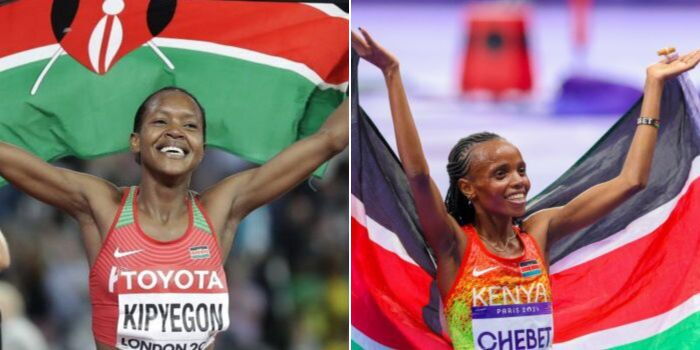
Kenya’s legendary middle- and long-distance queens, Faith Kipyegon and Beatrice Chebet, have once again catapulted the nation to the global spotlight by smashing world records at the prestigious 50th Prefontaine Classic held on Saturday, July 5, at Hayward Field in Eugene, Oregon, USA.
Faith Kipyegon, a reigning champion in her discipline, broke her own 1500m world record just a year after setting it. With a mind-blowing time of 3:48.68, Kipyegon lowered her previous mark by 0.36 seconds, solidifying her dominance as one of the greatest female middle-distance runners in history.
The new feat comes hot on the heels of her recent sub-four-minute mile attempt, a performance that, while ineligible for record purposes, would have also broken the world record.
Not to be outdone, Beatrice Chebet produced a jaw-dropping performance in the 5000m, becoming the first woman ever to run the race in under 14 minutes.
Chebet clocked 13:58.06, smashing Ethiopia’s Gudaf Tsegay’s previous record of 14:00.21 by more than two seconds. Her final sprint ignited shockwaves across the athletics world and marked a monumental moment in women’s distance running.
In a powerful show of Kenyan prowess, Chebet was followed by fellow countrywoman Agnes Jebet Ngetich, who placed second with a time of 14:01.29, while Gudaf Tsegay came in third at 14:04.41.
President William Ruto led the country in celebrating the sensational victories, posting on Sunday morning:
“We salute Faith Kipyegon and Beatrice Chebet for setting new world records in the women’s 1500m and 5000m events at the Prefontaine Classic.”
He also gave a special mention to Agnes Jebet Ngetich, praising her second-place finish as part of a dominant Kenyan performance on the global stage.
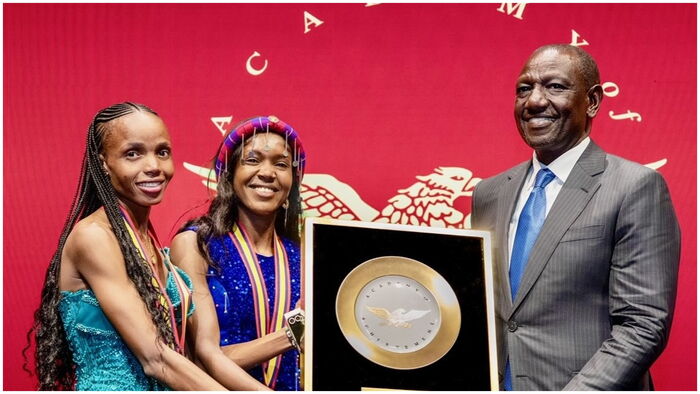
The golden streak of these two phenomenal athletes has not gone unnoticed. In 2024, both Kipyegon and Chebet were honoured by the prestigious Academy of Achievement, receiving their awards at the Dinner of the Golden Plate Awards Ceremony at the Lincoln Centre in New York. President Ruto himself presented the awards on September 22, 2024, and commended their commitment to excellence.
“The extraordinary honour is a solid tribute to your hard work, talent and dedication to athletics. No doubt, it will inspire upcoming athletes and help shape our country’s sports,” President Ruto said during the ceremony.
These achievements are more than just records, they are a celebration of Kenyan resilience, talent, and an ever-burning passion for distance running. Faith Kipyegon and Beatrice Chebet have once again reminded the world why Kenya is the true home of champions.
A photo collage of Kenyan athletics champions Faith Kipyegon(left) and Beatrice Chebet.Faith Kipyegon and Beatrice Chebet receiving the Academy of Achievement Award on Tuesday, September 24, 2024. PHOTO/ Faith Kipyegon. FacebookFaith Kipyegon preparing for a Breaking4 race in Paris on Thursday, June 26, 2025. Photo: Nike
In a dramatic escalation of Nairobi’s ongoing war against noise pollution, the County’s Chief Officer for Environment, Geoffrey Mosiria, was verbally attacked and threatened while responding to a disruptive event on Saturday, July 6.
Mosiria, who has gained a reputation for his unwavering crackdown on excessive noise, was carrying out his official duties when he was met with hostility from event organisers in the heart of Kilimani.
The incident took place during a high-volume event along Dennis Pritt Road, directly opposite the Roadhouse Grill and adjacent to the Spinal Injury Hospital, a facility that houses patients requiring rest and healing.
Ironically, the initial complaint had pointed to a popular club believed to be near the State House. But upon investigation, Mosiria’s team discovered that the true source of the noise was the open-air event nearby, which reportedly blasted music using massive sound systems akin to those used at large venues like Uhuru Park.
“I calmly and respectfully asked the organisers to reduce the volume or end the event in order to stop the clear case of noise pollution,” Mosiria stated in a press release on Sunday.
But instead of cooperating, the organisers lashed out with insults, threats, and even attempted to intimidate Mosiria with legal blackmail. One of them reportedly claimed they had a right to continue causing disruptive noise in the sensitive setting, an assertion Mosiria forcefully rejected.
The County Chief emphasized the serious implications of such noise, especially for patients undergoing care in nearby medical facilities.
“No one has the right to abuse the peace and dignity of our neighbourhoods, let alone put vulnerable hospital patients at risk,” he said. “It’s painful when public officers are harassed for simply doing their jobs, but this will not weaken our resolve.”
Despite the confrontation, Mosiria and his team stood their ground and ultimately managed to shut down the noise. He reiterated that Nairobi County will not retreat from its mission to enforce noise pollution laws and protect residents from unlawful disturbances.
“Let me say this clearly: We will not be bullied or silenced in our efforts to restore order in Nairobi,” Mosiria declared, adding a call for public cooperation and respect for officers working tirelessly to maintain sanity in the city.
His statement underlines a growing concern across Nairobi, where increasing cases of unregulated entertainment events and night-time noise are testing the limits of urban tolerance.
Mosiria’s confrontation has sparked public conversation around the rights of residents, patients, and public servants, bringing renewed urgency to the fight against unchecked urban noise.
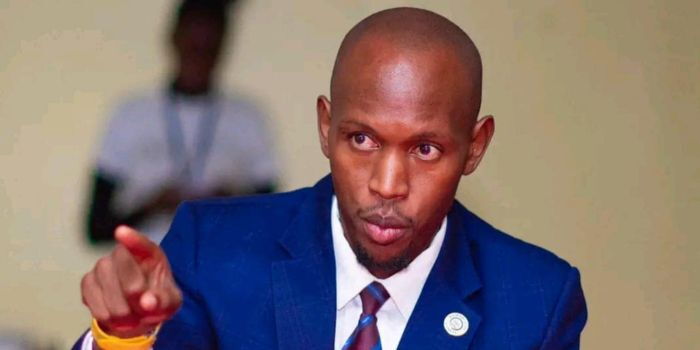
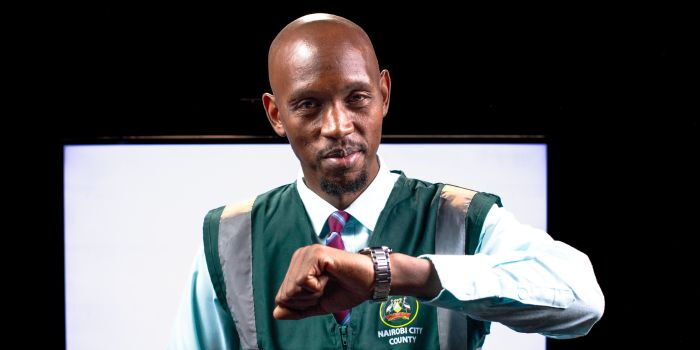
Nairobi Chief Officer of Environment Geoffrey Mosiria, November 26, 2024. Photo: Geoffery MosiriaNairobi City County Chief Officer for Environment Geoffrey Mosiria during his exclusive interview with Kenyans.co.ke on January 2025 at Kenyans.co.ke offices. Kenyans.co.keA photo of Geoffrey Mosiria standing next to kiangombe dumping site off Mombasa Road on March 27, 2025. Photo: Geoffrey Mosiria
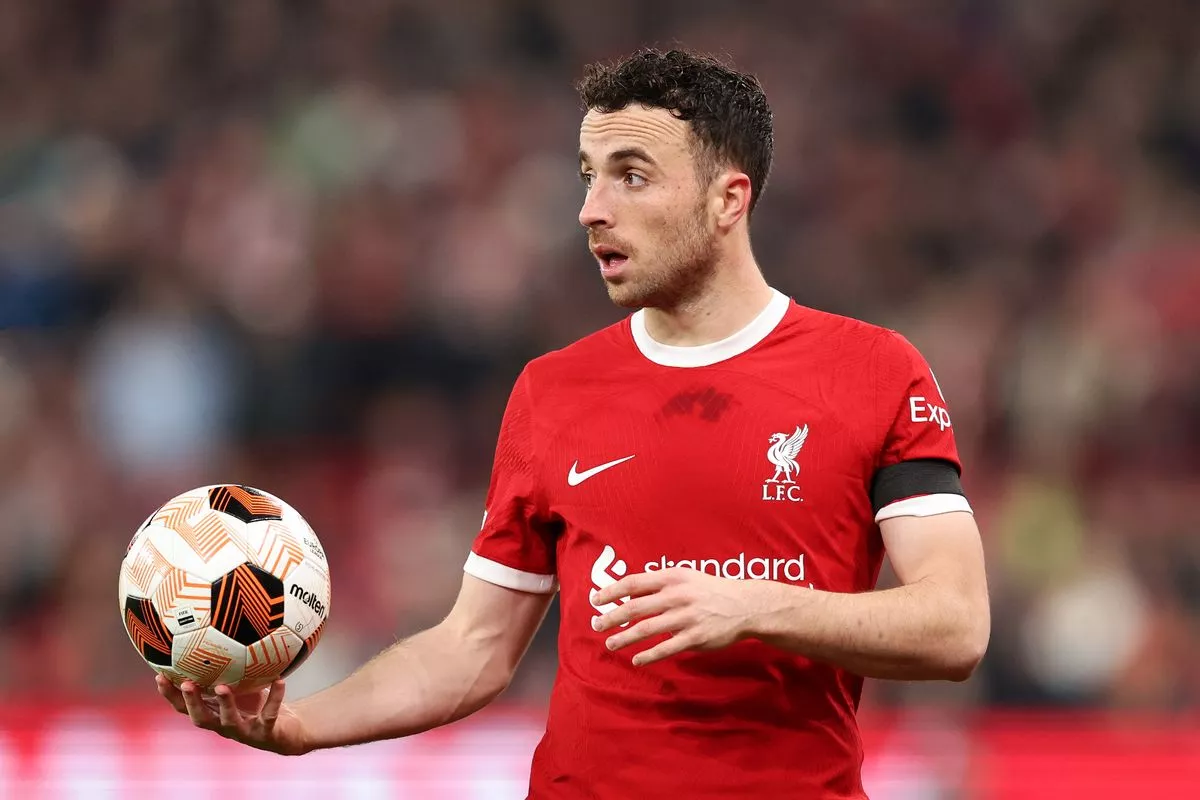
The football world continues to mourn the devastating loss of Liverpool forward Diogo Jota and his brother Andre, who tragically died in a car crash on Friday night.
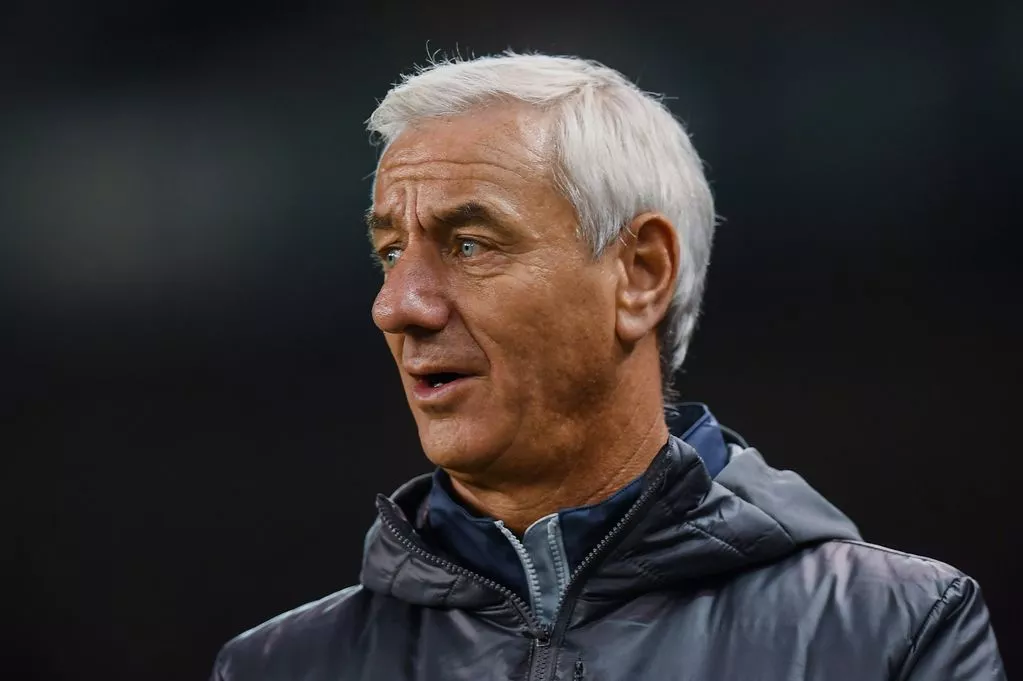
As tributes pour in from across the globe, Liverpool icon Ian Rush has shared an emotional message, one marked by deep personal sorrow as he navigates his own family tragedy.
Rush, who spent over a decade writing his name in Anfield history books, revealed he was unable to attend Jota’s funeral in Gondomar, Portugal, due to the recent death of his own older brother, Gerald.
While the Liverpool squad made the journey to pay their respects, Rush was immersed in the painful process of funeral arrangements for his sibling.
“I was invited to Diogo’s funeral, but what has happened with my brother passing it was impossible to go,” Rush explained. “He hadn’t been well for some time, but like Diogo it hasn’t really hit home yet.”
For Rush, the tragic news of Jota’s sudden passing stirred haunting memories of the 1989 Hillsborough disaster that claimed 97 lives.
“At Liverpool we have always regarded ourselves as one big family. Now one of our family has gone, so we all have to join together and help one another,” he said. “It was the same with Hillsborough… It doesn’t matter who you are, a player or a supporter, we all stick together.”
The revered Liverpool ambassador painted a heartfelt portrait of Jota, both as a footballer and a person. “Diogo was a great player, probably the best finisher at the club. He would make a difference whether he started or came on as a substitute. He would never dominate the headlines and that was the same off the pitch. He was a real gent. He just got on with things.”
Jota, just 28, had recently gotten married and was a father of three. His passing leaves a painful void not only at Anfield, but also in the hearts of fans in Portugal and beyond. The magnitude of grief has shaken the Liverpool squad, who are soon to return for pre-season training.
“This is especially hard for the players,” Rush noted. “They are expected to get on with the job, but they are human beings at the end of the day. For some, the enormity of what has happened hasn’t sunk in yet. I believe when someone dies, it’s only a few weeks later that the full extent of the awful loss gets you.”
Rush also drew parallels to the loss of another close friend and Welsh legend, Gary Speed, who died nearly 14 years ago. “He has never been forgotten… Wales loved Gary Speed as Portugal loved Diogo Jota, and Liverpool did as everyone can see with the scenes around Anfield.”
As Liverpool fans continue to leave tributes at Anfield and online, Rush’s poignant reflections remind us that football is more than just a game, it’s a family, bound by shared grief, resilience, and enduring memory.
Jota and his brother were tragically killed in a car crash (Image: Getty Images)Liverpool legend Ian Rush has paid tribute to Diogo Jota
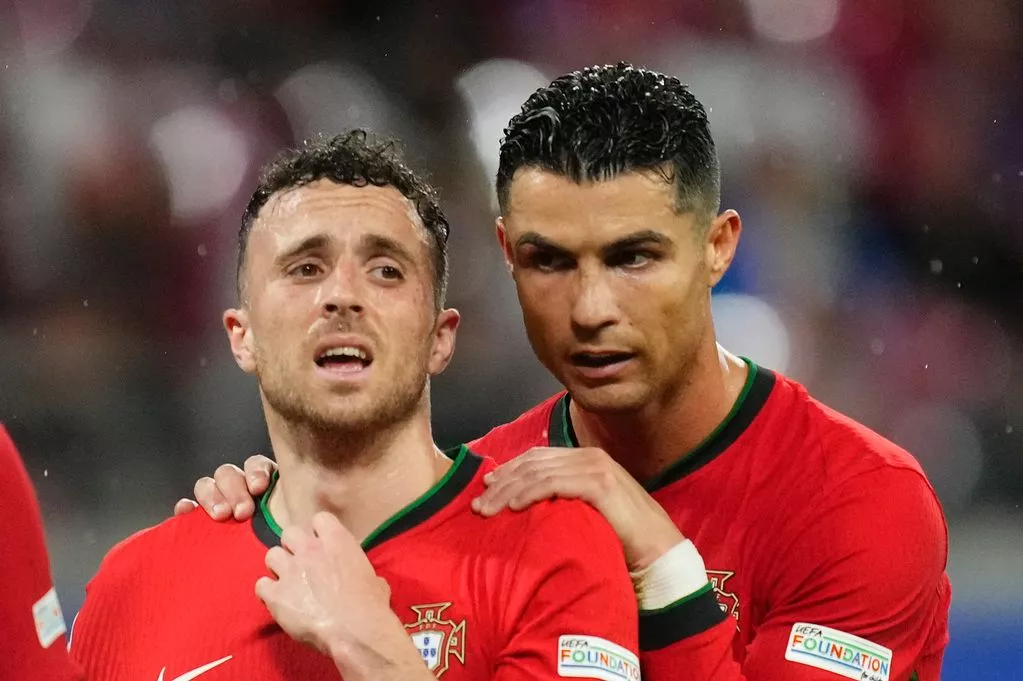
Cristiano Ronaldo’s absence at Diogo Jota’s funeral has sparked a whirlwind of reactions, but his sister, Katia Aveiro, has come out swinging in fierce defense of her brother.
As Portugal mourns the tragic loss of Diogo Jota and his brother Andre, both killed in a devastating car crash, Ronaldo chose not to attend the funeral held Saturday in Gondomar, near Porto. His reason? To avoid overshadowing the somber ceremony with his high-profile presence.
While many teammates of the late Jota were present to pay their respects, Ronaldo’s decision drew criticism on social media and from segments of the press. But his sister Katia wasn’t having it.
She delivered a powerful, emotionally charged response on Instagram, condemning what she called a “sick society” obsessed with celebrity appearances even in moments of grief.
Recalling the heartbreaking funeral of their father, Katia shared how her family was bombarded by cameras and onlookers: “At no time were we able to leave the chapel; it was only possible at the time of the burial, such was the commotion.”
She added that the chaos and media frenzy robbed them of a dignified moment of mourning, and she understood fully why Ronaldo would choose to avoid bringing similar attention to another grieving family.
“It is absurdly shameful to watch TV channels and commentators emphasising an absence rather than respectfully honouring the pain of a mutilated family,” Katia continued. “I feel sorry… And war is also like that. Human evil is also a war. And every day we have to fight against it.”
Ronaldo himself posted a heartfelt tribute online, expressing disbelief and sorrow over the deaths. “It doesn’t make sense. We were just together in the national team, and you had just gotten married,” he wrote. “To your family, your wife and your children, I send my condolences and wish them all the strength in the world… Rest in peace, Diogo and Andre. We will all miss you.”
Cristiano Ronaldo did not attend Diogo Jota’s funeralRonaldo’s sister Katia Alveiro has responded to criticism of her brother’s decision (Image: Instagram)
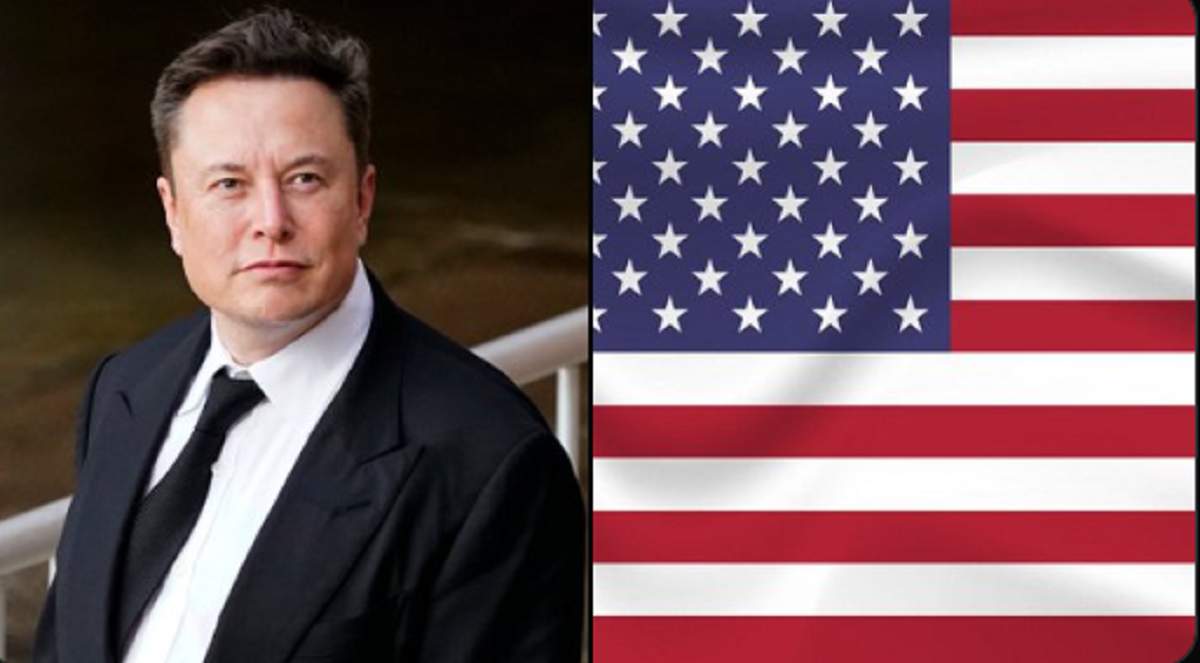
Elon Musk has taken another unpredictable leap into public life, this time by declaring the formation of a new political movement, the America Party.
His announcement followed a viral poll he posted on X, formerly Twitter, in which a majority of his followers supported the idea of creating a third party.
Hours later, Musk confirmed that the movement was no longer theoretical: “By a factor of 2 to 1, you want a new political party and you shall have it,” he declared.
He further accused America’s political system of functioning as a “one-party system, not a democracy,” promising that the America Party would give citizens back their freedom.
This announcement marks not only a personal political rupture, especially following his growing estrangement from Donald Trump, but also a potential realignment in American politics.
Musk, whose influence spans the worlds of tech, media, transportation, space exploration, and artificial intelligence, is uniquely positioned to leverage his platforms and following in ways few figures in history have ever attempted.
If the America Party transitions from an online declaration into a serious political machine, it could target strategically vital congressional seats, disrupt conservative strongholds, and appeal to a mix of disillusioned Republicans, independents, and younger libertarian-minded voters.
This would, in effect, force a reckoning within the GOP by siphoning off votes and injecting new issues into mainstream debate, particularly those around fiscal transparency, corruption, censorship, and regulatory overreach.
Beyond domestic politics, Musk’s new party could have profound global implications. As the founder of companies like Tesla, SpaceX, Neuralink, and xAI, his policy preferences have the potential to shape international conversations on AI regulation, space law, and tech governance.
A political platform that supports faster technological innovation, reduced government interference, and more aggressive space exploration would shift the conversation dramatically, not only in Washington but in global forums where issues like artificial intelligence safety and Mars colonization are increasingly urgent.
Yet despite the potential disruption, the challenges facing Musk’s new political vehicle are enormous. The American political system is deeply entrenched in its two-party structure. History has not been kind to third-party efforts.
Even the most charismatic or well-funded movements have struggled to gain traction under the weight of restrictive ballot laws, institutional inertia, and voter anxiety over so-called “wasted votes.”
For Musk, real political success will hinge not just on rhetoric or online momentum, but on execution, infrastructure, and the ability to translate a digital movement into ground-level organizing and electoral victories.
Reactions on X were explosive within minutes of Elon Musk’s announcement of the America Party. Supporters flooded timelines with enthusiastic praise, declaring Musk the only person capable of shaking up a system they see as corrupt and outdated.
One user wrote, “Elon just did in one tweet what millions of Americans have been begging for—burn the two-party illusion to the ground. #AmericaParty”. Others compared the move to a modern-day Boston Tea Party, saying Musk is the symbol of rebellion the country desperately needs.
Not everyone shared the excitement. Critics accused Musk of playing political games at a dangerous time for American democracy.
A widely shared post read, “This isn’t leadership, it’s billionaires treating our political system like a tech startup. No plan, no policy, just chaos.”
Some warned that the party could become a spoiler in the 2028 election, potentially helping Donald Trump by splitting the conservative vote. A former GOP strategist added, “If Musk is serious, Trump should be worried. But if he’s not, we all should be.”
Others took a more cynical or humorous view of the situation. A viral meme showed the “America Party” logo Photoshopped onto a Tesla, crashing into a red and blue elephant-donkey hybrid.
One user joked, “If the America Party runs on Dogecoin and builds voting booths on Mars, I’m in.”
Another added, “So let me get this straight… we’re trading career politicians for a guy who livestreams flamethrowers and spaceship launches? Peak 2025.”
Amid the noise, some voices tried to cut through the chaos. Independent journalists and political analysts noted that while Musk’s cultural power is undeniable, creating a viable third party requires more than tweets, it requires legal, financial, and organizational groundwork.
Still, one observer captured the moment’s gravity by tweeting, “Mock it if you want, but when Elon Musk declares war on the establishment, the world listens. The question isn’t whether he can start a party, it’s whether we’re about to live through a political tech revolution.”
For now, the America Party remains more of an idea than an institution. But in the age of digital populism, where memes spread faster than manifestos and billionaires wield social platforms like megaphones, even the suggestion of a Musk-led party has already shifted the narrative.
Whether that leads to a political transformation, or simply another flash of chaos in an already unpredictable era, will depend on what Musk does next.
His words have sparked both curiosity and concern: “The America Party is for the people who’ve been ignored, lied to, and taxed into silence. That ends now.” The real question is whether this promise turns into a revolution, or fades like so many third-party dreams before it.
Elon Musk announces new America Party to challenge the U.S. political status quo
Elon Musk has officially launched a new political party called the America Party, boldly declaring a war on what he calls the U.S. “one-party system.”
The billionaire tech mogul and owner of X (formerly Twitter) made the announcement Saturday night, just hours after conducting a viral poll on his platform asking followers whether America needed a new political force.
The results were overwhelmingly in favor of the idea. “By a factor of 2 to 1, you want a new political party and you shall have it!” Musk posted.
He continued with a scathing critique of both major parties: “When it comes to bankrupting our country with waste & graft, we live in a one-party system, not a democracy. Today, the America Party is formed to give you back your freedom.”
The announcement comes amid growing tensions between Musk and Republican President Donald Trump. Once allies on key issues, their relationship has soured in recent months, with Musk increasingly positioning himself as politically independent, or, perhaps now, a disruptor carving a third path entirely.
This could signal a seismic shift in American politics, especially considering Musk’s massive influence across social media, tech, and financial spaces.
The rapid rollout of the America Party caught many off guard, with political analysts now scrambling to predict its potential impact on the 2028 elections.
Although further details about the party’s structure, leadership, and platform are still emerging, the billionaire’s language suggests a populist message focused on government accountability, anti-corruption, and civil liberties.
As Musk concluded in his now-viral post:
“The America Party is for the people who’ve been ignored, lied to, and taxed into silence. That ends now.”
This story is developing. Expect further updates as more is revealed about Musk’s vision, political strategy, and potential candidates aligned with the America Party.
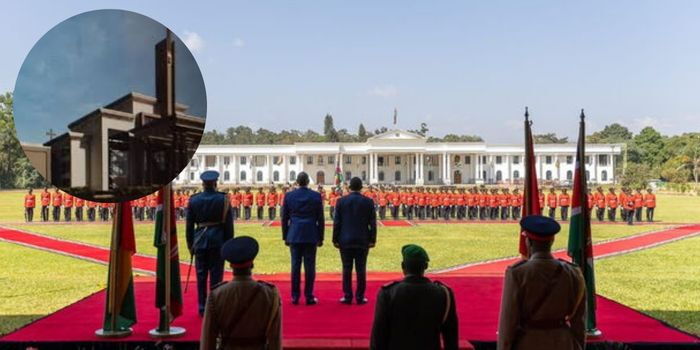
A fresh wave of religious debate has emerged in Kenya following President William Ruto’s passionate defense of the Ksh 1.2 billion church construction at State House, a move that has now prompted Muslim leaders to demand equal representation within the presidential compound.
On Friday, July 5, President Ruto addressed the nation from State House, Nairobi, boldly responding to widespread backlash over the mega church project.
Amid claims that he was misusing taxpayer funds, the President stated unequivocally, “I have no apologies to make for building a church at State House.” He clarified that the money used was not from public coffers but from his personal resources, citing his unwavering Christian faith as the motivation.
“When I was elected, we came in to find an iron sheet church in the State House,” said Ruto. “The construction of the Church is not costing the government a single cent. I will build the church with my own money because the church of God is something that demands respect.”
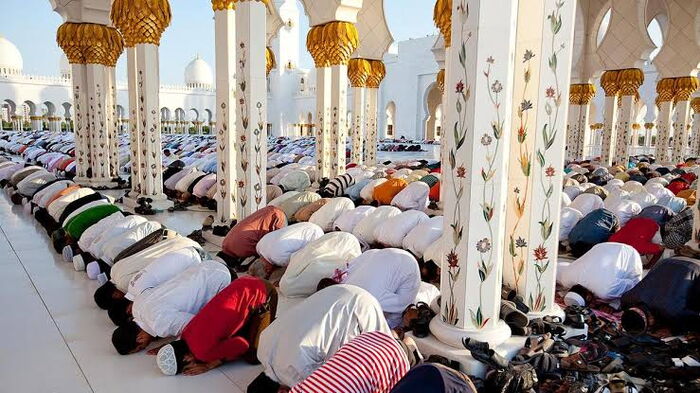
But his remarks appear to have sparked a religious balancing act. In response, Muslim leaders across the country have raised concerns about the exclusive focus on Christianity in a public institution that symbolically represents all Kenyans.
Leading the calls is Sheikh Abu Qatada from the Pwani Patriotic Religious Leaders group, who emphasized the importance of inclusivity in the State House’s religious facilities.
“We are also raising our voices and asking that, since the State House is a place that represents all religions, and Christians already have a church, we too ask for a mosque,” said the Sheikh.
He added, “That way, when we are at the State House, we can also have a place to pray.”
Their demands highlight the broader conversation on religious equity in national institutions, especially within spaces like State House, which, though occupied by a sitting president, serves as a national symbol beyond individual faiths.
The request from Muslim leaders is not merely symbolic but rooted in the constitutional principle of religious freedom and equality.
They argue that State House, being a representation of all Kenyans, must reflect the country’s religious diversity without leaning toward one faith.
As the controversy simmers, questions now arise: Will President Ruto heed the Muslim leaders’ request? And will this set a new precedent for religious inclusion in Kenya’s most powerful office?
What remains clear is that the intersection of politics, religion, and national identity has once again ignited a spirited public conversation, one that demands careful navigation in a country proud of its multi-faith fabric.
President William Ruto and DP Kithure Kindiki at State House, July 4, 2025. PCSMuslims praying in Mombasa County on April 10, 2024. Photo: Hassan JohoPhoto of Muslims Conducting prayers. Photo
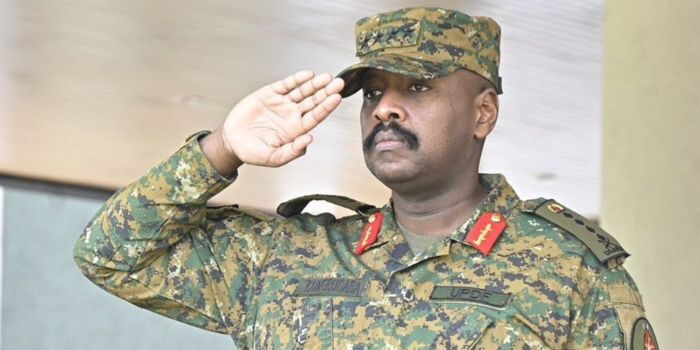
Uganda’s Chief of Defence Forces, General Muhoozi Kainerugaba, has once again ignited regional tensions, this time with a blistering online critique of Kenya’s leadership in the UN-backed Multinational Security Support (MSS) Mission in Haiti.
In a barrage of fiery tweets posted to his official X account, the outspoken General accused Kenyan police of failing to stabilize Haiti, boldly claiming that Uganda’s People’s Defence Forces (UPDF) could swiftly succeed where Kenya has “struggled.”
“It would take us one month to capture Port-au-Prince,” Muhoozi asserted, referring to Haiti’s heavily gang-infested capital.
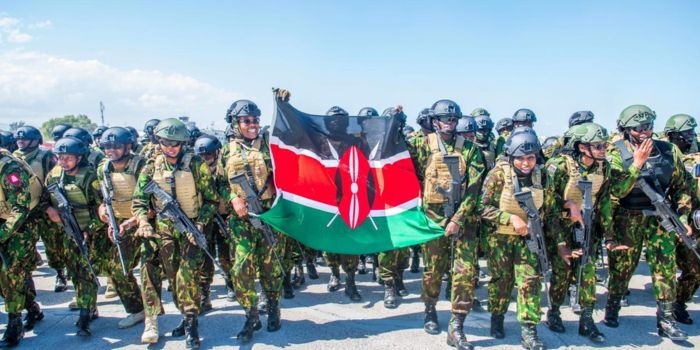
His comments come as Kenya marks the first anniversary of leading the controversial MSS Mission aimed at restoring order in a country ravaged by violent gangs and political instability. As of May, Kenya had deployed 800 police officers to bolster the Haitian National Police (HNP) in their struggle against well-armed criminal groups.
Despite the mission celebrating some key wins, such as reclaiming critical infrastructure in Port-au-Prince including hospitals, schools, and the main airport, the mission faces mounting scrutiny. A recent alarm from UN Secretary-General Antonio Guterres warned that without proper funding and logistics, the progress made could be short-lived.
Muhoozi didn’t stop at criticism. He invited the United Nations to cancel Kenya’s role in the Caribbean operation and instead negotiate directly with Uganda to take over the anti-gang initiative.
“The Kenyans have failed after nearly 2 years…that’s what we expected. The UN is welcome to offer us favourable terms,” he wrote.
Muhoozi’s remarks come just ten days before the mission is set to conclude its initial term. His proposal to replace Kenya with the UPDF reads like a political grenade, timed precisely when global attention is fixed on Haiti’s volatile situation and Kenya’s performance on the international stage.
Notably, this isn’t Muhoozi’s first time triggering a diplomatic row with Nairobi. In 2022, the General notoriously tweeted that it would take the UPDF just two weeks to capture Kenya’s capital, Nairobi, a remark that forced Ugandan President Yoweri Museveni, who is also Muhoozi’s father, to issue a formal apology to Kenya.
As regional observers brace for potential fallout, Muhoozi’s latest outburst reopens old wounds and tests East Africa’s delicate military and diplomatic balance.
Gen Muhoozi Kainerugaba, Chief of Defence Forces (UPDF) and SPA/SO, July 1, 2025. Photo: Gen MuhooziKenyan police officers and their counterparts from the MSS mission during an assessment of the APN Port in Haiti on May 26, 2025. Photo: MSS HaitiThe fourth contingent of Kenyan police officers arriving at the Toussaint Louverture International Airport (TLIA) in Haiti on February 6, 2025. Photo: MSS
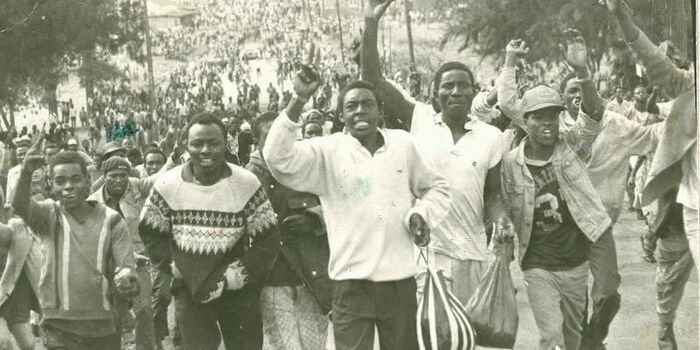
Every year on July 7, Kenyans pause to remember a pivotal moment that changed the country’s political course, Saba Saba.
More than a date, it is a movement born in resistance and nurtured in sacrifice. Its roots go back to 1990, when a handful of daring leaders challenged the autocratic grip of President Daniel Arap Moi’s KANU regime. The echoes of that resistance continue to shape Kenya’s political consciousness to this day.
It was on July 7, 1990, that opposition leaders Kenneth Matiba, Charles Rubia, and Jaramogi Oginga Odinga called for a rally at Kamukunji Grounds in Nairobi, demanding the return of multiparty democracy.
The government banned the rally, but thousands defied the order. What followed was chaos, marked by violent crackdowns, arrests, and bloodshed. Matiba and Rubia were swiftly detained. Odinga, a political elder and symbol of resistance, stood firm with the people, reinforcing the call for democracy.
In the same breath of rebellion, a young James Orengo spoke boldly in forums, only to face arrest himself. Raila Odinga, fresh from previous detentions between 1982 and 1988, reaffirmed his commitment to the pro-democracy wave.
Koigi wa Wamwere, undeterred by fear, spoke out in defense of civil rights and joined the long list of detainees. Wangari Maathai, unwavering and brave, condemned the regime’s brutality and mobilized women’s groups to resist state violence.
Saba Saba’s power didn’t end in the 1990s. It evolved and re-emerged each time injustice reared its head. In 1997, Koigi wa Wamwere returned to the streets to denounce electoral fraud.
Raila Odinga, ever the political force, maintained his advocacy through 1997, 2001, 2005, and as recently as 2023, continuing to challenge authoritarian tendencies, campaign for free and fair elections, oppose flawed constitutional referendums, and lead mass rallies against economic injustice.
Wangari Maathai, in 2003, shifted the protest lens to environmental justice, leading a bold march for land restitution. Paul Muite emerged around the same time, championing a people-led constitutional process and resisting top-down political manipulation during the 2005 referendum.
As Kenya transitioned into a new era, a fresh generation of activists carried forward Saba Saba’s flame. In 2008, Maina Kiai led a candlelight vigil to honor post-election violence victims. The 2010 Constitution, hailed by Ndung’u Wainaina and Gladwell Otieno, was celebrated as a victory born from the very seeds planted in 1990.
By 2013 and 2014, Boniface Mwangi had become the defiant voice of Kenyan youth. He marched against corruption, land grabbing, and extrajudicial killings.
Human rights lawyer Harun Ndubi followed suit in 2016, taking to the streets and being arrested while protesting police brutality.
In 2020, Boniface Akumu rallied youth in Mathare and Kayole, standing up against systemic oppression during the COVID-19 lockdowns.
Gacheke Gachihi condemned the silent war on youth in informal settlements, while Jerotich Seii led a powerful Saba Saba walk in 2021, her rallying cry simple yet profound: “We are tired.”
And still, in 2024, Saba Saba lived on, not through fire and tear gas, but through music and remembrance.
A national concert honored the fallen, the fighters, and those still marching for change. From Matiba to Mwangi, from Kamukunji to Mathare, the legacy of Saba Saba continues to shape Kenya’s political identity.
Saba Saba was never just a protest. It was a revolution in spirit, an uprising of ordinary people against extraordinary repression. That spirit endures, because the fight for justice, dignity, and democracy in Kenya is far from over.
Demonstrators pictured in Nairobi during the first ever Saba Saba rally on July 7, 1990. The StandardDemonstrators display a banner during Saba Saba demonstrations. FileActivist Wanjiru Njira’s encounter with police in Nairobi during the Saba Saba match on Tuesday, July 7, 2020. Twitter
Nairobi, Kenya – July 4, 2025 Rwandans living in Kenya, together with friends of Rwanda and members of the diplomatic corps, gathered at the Rwanda High Commission in Nairobi to commemorate the 31st anniversary of Rwanda’s Liberation Day, known as Kwibohora 31. The event was marked with deep reflection, cultural expression, and a reaffirmation of the enduring bonds between Rwanda and Kenya.
In his keynote address, H.E. Amb. Ernest Rwamucyo, the High Commissioner of the Republic of Rwanda to Kenya, welcomed guests with warmth and gratitude, stating:
«I wish to begin by warmly welcoming you to Rwanda High Commission. Thank you for joining us on this important occasion as we celebrate the 31st anniversary of Rwanda’s liberation. Our liberation is known as Kwibohora. »
The ceremony was graced by Dr. Caroline Wanjiru Karugu, the Principal Secretary of the State Department for East African Community, who represented the Government of Kenya as the chief guest. She received praise for donning a beautiful Rwandan traditional outfit in honor of the occasion.
A Journey from Tragedy to Triumph
Liberation Day marks the end of the 1994 Genocide against the Tutsi and the beginning of Rwanda’s journey toward recovery. Ambassador Rwamucyo paid tribute to the brave men and women of the Rwandan Patriotic Front (RPF) and the former Rwandan Patriotic Army (RPA), now Rwanda Defence Force (RDF), led by His Excellency President Paul Kagame.
«This important day signifies the beginning of Rwanda’s transition from an oppressive regime to a modern, democratic, and forward-looking nation, » said the Ambassador.
He emphasized how Kwibohora represents more than just political liberation it signifies Rwanda’s rebirth, reconciliation, and transformation. The ambassador encouraged all present to view Liberation Day not just as a historic memory, but as a call to build a better, unified society.
Development Built on Unity and Vision
Highlighting Rwanda’s post-genocide achievements, Ambassador Rwamucyo noted that the country has made significant strides in poverty reduction, education, health care, technological innovation, and gender equality.
According to the Rwanda Integrated Household Living Conditions Survey (EICV7), Rwanda reduced its poverty rate from 39.8% in 2017 to 27.4% in 2024. Extreme poverty dropped from 11.3% to 5.4%. These outcomes, he emphasized, reflect the impact of inclusive governance and citizen-centered policies.
«Life expectancy has risen from 51 years in 2002 to nearly 70 years in 2022. Primary school enrollment now covers 96% of eligible children and 95% of Rwandans have access to community-based health insurance, » he added.
Rwanda has also emerged as a key global contributor to peacekeeping, ranking as the second-largest contributor to UN peace operations with over 5,000 deployed personnel.
Kenya-Rwanda Relations: A Model of Pan-African Partnership
Ambassador Rwamucyo praised the deep and enduring relationship between Rwanda and Kenya, describing it as rooted in «shared values, mutual respect, and a strong Pan-African spirit. » He acknowledged the presence of Kenyan institutions that have supported Rwanda’s development journey particularly in education, security, tourism, and hospitality.
«Kenya has stood by Rwanda in our moments of greatest need and continues to walk with us in pursuit of sustainable development, peace, and prosperity, » he said.
The ambassador also thanked the diplomatic community and Rwanda’s development partners for their unwavering support.
A Call to Responsibility and Continued Transformation
Quoting President Paul Kagame, Ambassador Rwamucyo reminded the audience:
«Liberation is not a single event or an endpoint. It is an attitude that inspires everything we do, and without which we cannot succeed. »
He urged Rwandans to honor the legacy of liberation through continued service, responsibility, and collective effort.
«Let this day be a reminder of what can be achieved when people come together with a shared vision and courage to pursue it, even against all odds. »
Celebrating with Culture and Unity
The celebration was also enriched with vibrant cultural performances by Rwandan students in Kenya, showcasing traditional dance and music, reinforcing the unity and pride of the Rwandan community abroad.
As the ceremony concluded, a toast was proposed by the Ambassador in honor of Rwanda’s ongoing journey and in appreciation of Kenya’s steadfast friendship.
Kwibohora31 served not only as a commemoration of Rwanda’s historic liberation but also as a testament to the power of resilience, leadership, and partnership in nation building.