Home Blog Page 21

From legacy to leadership: Eng. Sayinzoga takes over after Marie Ingabireโ€™s passing

0

Rwandans had been waiting with growing anticipation to learn who would succeed Madam Marie Immaculรฉe Ingabire, the revered anti-corruption crusader who passed away on October 9, 2025. Her death left a profound void not only within Transparency International Rwanda but also across the broader landscape of governance, civil society, and public service in the country. As Chairperson of Transparency International Rwanda, she embodied courage, integrity, and an unwavering commitment to fighting corruption and promoting ethical leadership in Rwandan society.

Throughout her tenure, Marie Immaculรฉe Ingabire became the public face of the struggle for accountability and good governance. She consistently emphasized that combating corruption was not the responsibility of government institutions alone, but a shared duty requiring citizen vigilance and participation. Her voice resonated in national dialogues, international forums, and grassroots campaigns that encouraged transparency and the reporting of malpractice. She was widely respected for her fearlessness, moral clarity, and determination to place the public interest above all else.

Tributes poured in from across the political spectrum, from state institutions, private sector leaders, and ordinary citizens who admired her dedication. Many described her as a pillar of integrity whose legacy extended beyond institutional reforms to shaping a culture of honesty and responsibility. Her leadership strengthened the credibility of Transparency International Rwanda and reinforced the importance of civic engagement in safeguarding public resources.

On February 15, 2026, during the organizationโ€™s General Assembly, Transparency International Rwanda officially announced her successor. Eng. Appollinaire Sayinzoga Nkongoli, who had served as First Vice President since 2021, was elected to lead the organization into its next chapter. His prior leadership experience within the institution positions him as a continuity candidate, familiar with its mission, operational framework, and strategic direction.

Observers note that while continuity may ensure stability, the new leadership will face evolving challenges in the fight against corruption. Strengthening institutional accountability, adapting to emerging governance risks, and maintaining public trust will require renewed energy and innovation. The expectations are high, not only because of the organizationโ€™s critical role in Rwandaโ€™s governance framework, but also because of the powerful legacy left behind.

As Rwanda continues to pursue sustainable development and institutional reform, the fight against corruption remains central to its national aspirations. Marie Immaculรฉe Ingabireโ€™s name will endure as a symbol of principled leadership and civic courage. The responsibility now rests with the new chairperson to honour that legacy, deepen the culture of transparency, and ensure that integrity remains a defining pillar of Rwandaโ€™s future.

AI for humanity: inside Indiaโ€™s 2026 Summit shaping the future of global governance

0

As artificial intelligence accelerates its transformation of economies, societies and public institutions, the conversation is no longer about whether AI will shape our future, but about how we will shape AI. The India AI Impact Summit 2026 arrives at a pivotal moment, grounded in the principles of People, Planet and Progress. Its mission is clear: ensure that artificial intelligence advances humanity, drives inclusive growth, and protects the shared global commons that sustain us all.

At a time when technological breakthroughs often outpace regulation, the Summit places human wellbeing at the center of innovation. From healthcare systems strengthened by predictive analytics to climate models powered by machine learning, AI holds enormous potential to improve lives. Yet without responsible governance, transparency and equity, these same technologies risk deepening inequality, amplifying bias and undermining trust. The challenge before global leaders is to balance innovation with accountability.

In this critical context, the United Nations Office for Digital and Emerging Technologies (ODET) will convene a series of high-level side events on the margins of the Summit. These sessions are designed not as symbolic discussions, but as strategic interventions aimed at shaping the global AI agenda. By bringing together senior policymakers, scientists, industry leaders and civil society voices, ODET seeks to elevate evidence-based policymaking at a time when speculation and political rhetoric often dominate technology debates.

Central to these discussions is the role of scientific evidence in international AI governance. Effective governance cannot be built on assumptions or fragmented national interests. It must be rooted in rigorous research, transparent data and interdisciplinary collaboration. As AI systems grow more complex and autonomous, policymakers require access to independent scientific expertise to understand risks, measure societal impact and design adaptive regulatory frameworks. Evidence-based governance offers a pathway to harmonized global standards that encourage innovation while preventing harm.

Another urgent focus of the side events is strengthening safeguards for childrenโ€™s safety and wellbeing in the digital age. AI-driven platforms increasingly shape how young people learn, communicate and access information. While these tools offer educational opportunities and expanded connectivity, they also expose children to new forms of risk, including data exploitation, algorithmic manipulation and harmful content amplification. Establishing stronger global safeguards is not optional; it is an ethical imperative. Protecting children in AI-enabled environments demands coordinated international action, clear accountability mechanisms and sustained investment in digital literacy.

The Summit will also explore how artificial intelligence can redefine global development beyond the framework of the Sustainable Development Goals. While the SDGs remain a critical benchmark, AI presents opportunities to rethink development itself. Intelligent systems can optimize resource distribution, improve disaster response, enhance agricultural productivity and accelerate scientific discovery. However, equitable access to AI infrastructure, data and skills remains uneven across regions. Bridging this digital divide is essential if AI is to serve as a catalyst for shared prosperity rather than a driver of geopolitical imbalance.

Indiaโ€™s leadership in hosting this Summit signals the growing role of emerging economies in shaping global technology governance. As nations in the Global South expand their digital capacities, they bring new perspectives to debates historically dominated by a handful of technological powers. Inclusive governance must reflect diverse cultural, economic and social realities. AI designed for global benefit cannot be guided by narrow interests.

The India AI Impact Summit 2026 is more than a convening of experts; it is a statement of intent. By anchoring discussions in People, Planet and Progress, the Summit reframes artificial intelligence not merely as a tool of economic competition, but as a shared responsibility. Through evidence-based governance, stronger protections for vulnerable populations and a renewed vision for sustainable development, the international community has an opportunity to ensure that AI becomes a force for collective advancement.

The decisions made today will define the digital architecture of tomorrow. If guided by science, ethics and global cooperation, artificial intelligence can indeed advance humanity while safeguarding the world we share.

Rosa Mapendo in Kenya: โ€œWar is businessโ€ Banyamulenge activist demands global action at Makanika memorial

0

NAIROBI, Kenya ย Members of the Banyamulenge community gathered in Kenya on February 19, 2026, to mark the first anniversary of the death of General Michel Rukunda, widely known as Makanika, alongside others who were killed with him. The commemoration brought together community leaders, activists and members of the diaspora in an event defined by prayer, remembrance and renewed calls for unity.

Among the speakers was Rosa Mapendo, a Banyamulenge human rights activist based in Phoenix, Arizona, who traveled to Kenya to attend the ceremony. Introducing herself as a survivor of the 1998 violence in the Democratic Republic of Congo, Mapendo said she was speaking on behalf of members of the community living in the United States and others in the diaspora.

Standing before the audience, she described her appearance as both painful and necessary. โ€œWe have spoken for many years,โ€ she said, โ€œbut action has not followed.โ€ She emphasized that her message was not only for her own community, but also for those outside it who may not fully understand the scale of suffering endured in eastern Congo.

Mapendo recounted her personal experience of surviving what she described as a death camp, where she said she spent 16 months under armed guard with her seven children after her husband was killed alongside dozens of other men. She was pregnant at the time, with her youngest child just ten months old. โ€œI am who I am today because God saved me,โ€ she said. โ€œBut I know what injustice looks like.โ€

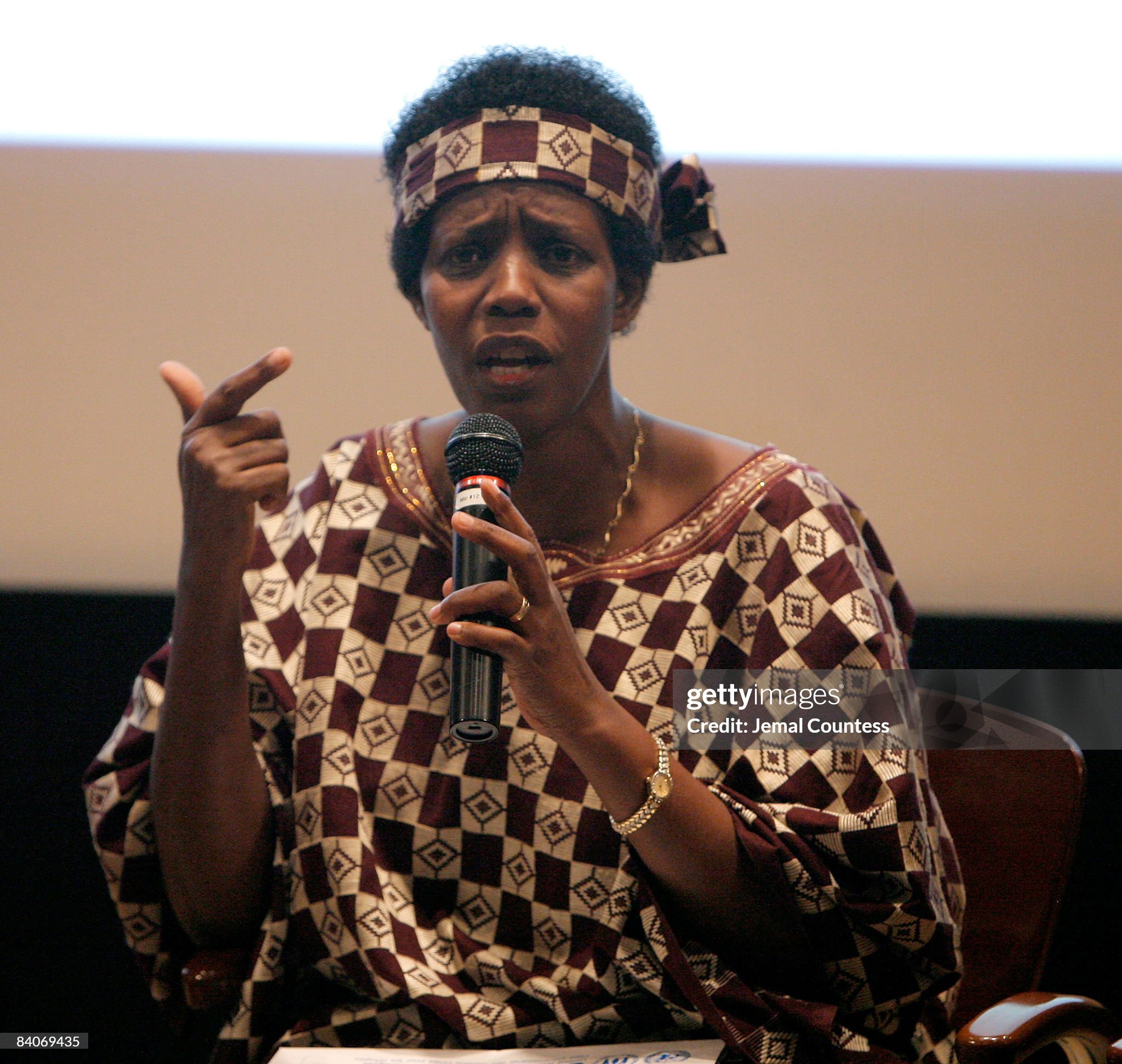
NEW YORK – DECEMBER 17: Human Rights activist Rose Mapendo speaks during the “Gimme Shelter” campaign launch at the United Nations Headquarters on December 17, 2008 in New York City. (Photo by Jemal Countess/Getty Images)

In her remarks, Mapendo reflected on an earlier visit to the United Nations, where she had been invited to speak. She described visiting a Jewish museum and hearing repeated declarations of โ€œNever againโ€ in reference to the Holocaust. She said she questioned why similar urgency did not appear to apply to ongoing violence in Congo.

โ€œIs this a business?โ€ she recalled asking, referring to war and mass atrocities. She recounted a conversation with a senior politician who allegedly told her that conflict is often driven by economic interests, pointing to the global demand for minerals sourced from Congo. โ€œWar is business,โ€ she quoted him as saying, adding that many of the materials used in everyday electronic devices originate in the region.

Her remarks underscored a broader argument: that geopolitical and economic interests often outweigh humanitarian concerns. โ€œNo one will shed blood on your behalf without an interest,โ€ she told the audience. โ€œIf we want to live in dignity, we must stand for our own rights.โ€

Addressing Kenyan authorities, Mapendo expressed gratitude for the countryโ€™s hosting of refugees, while urging leaders to use their diplomatic influence to advocate for peace and protection of civilians in the Great Lakes region. โ€œA president has the power to speak to another president,โ€ she said. โ€œAction speaks louder than a million words.โ€

She also criticized what she described as repeated rounds of international negotiations in countries such as Angola, Qatar and the United States, arguing that for affected communities, these diplomatic processes can appear disconnected from realities on the ground.

Throughout her speech, Mapendo returned to themes of resilience and unity. She offered condolences to widows and families who have lost loved ones, saying she understood the burden of raising children alone. At the same time, she encouraged women and young people not to give up. โ€œUnity is power,โ€ she said. โ€œA divided people cannot stand.โ€

General Michel Rukunda, known by his supporters as Makanika, remains a controversial figure in the conflict dynamics of eastern Congo. For those gathered in Kenya, however, the focus was less on military strategy and more on what they described as his legacy of resistance and self-defense.

As the ceremony concluded, speakers framed the commemoration not only as a memorial, but as a call to continued advocacy. While acknowledging that those killed will not return, participants emphasized that remembrance, in their view, carries an obligation: to seek justice, to demand accountability and to protect the next generation.

For many in attendance, the anniversary was both a moment of grief and a reaffirmation of identity ย an assertion that, despite displacement and loss, their community endures.

From courtrooms to controversy: the untold story of Dorothy Muoma that shook Kenya

0

The death of Dorothy Muoma has ignited a storm across Kenyaโ€™s social and political landscape, not merely because a life was lost, but because her story exposes uncomfortable truths about power, silence and institutional responsibility. What began as viral posts mourning a once-promising lawyer quickly evolved into a national debate about justice, mental health and the treatment of professionals who fall through the cracks?

In the days following her death on February 3, 2026, at Moi Teaching and Referral Hospital, social media platforms were flooded with contrasting images of Muomaโ€™s life. In some, she appeared confident and accomplished, a legal mind who had earned her place in Kenyaโ€™s courts. In others, she seemed overwhelmed by visible hardship, a stark reminder of how fragile professional success can become in the absence of support.

Public sympathy soon turned into controversy when claims circulated that she had once served as a magistrate in Kitale. The narrative spread rapidly, prompting an official response from the Judiciary of Kenya, which clarified that Muoma had never been employed as a magistrate or judge. The statement, intended to correct the record, instead intensified the conversation. The question shifted from whether she held judicial office to why so many believed she did, and why her suffering had remained largely invisible until her death.

Muomaโ€™s professional background was not in dispute. She trained in law, qualified as an advocate and practiced within Kenyaโ€™s legal system. Yet her later years were marked by serious health challenges, reportedly including long-term mental health struggles that affected her stability and career trajectory. For many Kenyans, the most troubling aspect of her story is not the debate over titles, but the apparent absence of sustained institutional support for a trained legal professional facing illness.

Mental health remains deeply stigmatized in Kenya, particularly within elite professions where strength and composure are often mistaken for invulnerability. Lawyers argue cases about justice and rights daily, but rarely discuss their own psychological burdens. When illness enters the picture, silence often follows. Muomaโ€™s story has forced the legal fraternity and public institutions to confront a painful question: what systems exist to protect professionals who become vulnerable?

The reaction online reflects more than grief. It reveals frustration with a system perceived as reactive rather than preventative. Kenyans have asked why a qualified advocate could struggle publicly without meaningful intervention. They have questioned whether the legal profession provides adequate mental health resources. Others have gone further, suggesting that the case highlights broader political and social neglect, where recognition is swift in success but slow in crisis.

There is also a political dimension to the national conversation. Institutions are quick to defend their reputations, as seen in the Judiciaryโ€™s clarification. Yet critics argue that safeguarding institutional image should not overshadow deeper reflection about support structures for legal practitioners and civil servants. The debate has moved beyond personal tragedy into the realm of public accountability.

Dorothy Muomaโ€™s life and death now stand as a symbol of something larger than one individualโ€™s misfortune. They represent the thin line between professional prestige and social abandonment. They underscore how easily society can overlook warning signs until a story becomes viral. And they challenge policymakers to address mental health not as a private weakness but as a public concern.

In death, Muoma has sparked a national reckoning. The sympathy expressed online must now translate into meaningful reform, whether through strengthened mental health programs within the legal sector, clearer professional welfare policies, or broader cultural shifts that reduce stigma. Without that, the cycle will repeat: a talented professional will fall, the public will mourn, institutions will clarify, and nothing substantial will change.

Dorothy Muoma can no longer speak for herself. But the questions her story has raised remain urgent. Kenya must decide whether her name will fade as another trending topic or endure as a catalyst for justice and systemic reform.

We sleep in the rain like animals, inside the harsh reality of Congolese refugees in Burundi

0

In southern Burundi, near the border with the Democratic Republic of Congo (DRC), lies the Cishemere refugee camp. This is where thousands of Congolese families have fled, escaping violence and insecurity in the provinces of North and South Kivu. Yet even after fleeing bullets and armed conflict, life in the camp remains harsh, marked by rain-soaked nights, hunger, and deep uncertainty about the future.

Many refugees say the tents they live in cannot protect them from heavy rain and strong winds. When night falls, some try to squeeze into the driest corners of torn shelters, while others remain seated through the night because the ground is flooded.

One man who fled with his family said: โ€œWhen we sleep, the rain falls on us like animals. Water enters the tent, and we sleep in mud and cold.โ€

Children are the most affected. Parents report a rise in coughs, flu, and illnesses linked to poor sanitation, especially during the rainy season.

Another major challenge in Cishemere is the lack of food. Refugees say food aid is often insufficient and sometimes arrives late. As a result, many families are forced to reduce their meals, with some eating only once a day.

Clean water is also scarce. Large crowds line up at a single water point, and the supply is not enough for everyone. Women and children often spend hours fetching water, leaving little time for school or other activities.

Many parents say their children have nowhere to study. Although a few temporary learning spaces have been set up, they are overcrowded and lack basic materials. Some children fall behind in their studies, while others miss out on education altogether.

Despite the difficult conditions, refugees in Cishemere continue to hope that one day peace will return to their homeland. Most say they do not want to live in camps forever; they simply want stability so they can rebuild their lives back home.

Humanitarian agencies are calling for increased international support to improve living conditions, through stronger shelters, more food supplies, clean water, and access to education.

The Cishemere camp reflects the harsh reality faced by many refugees in the Great Lakes region. They escape war, only to find themselves struggling for survival in overcrowded camps. The words โ€œwhen we sleep, the rain falls on us like animalsโ€ do not only describe the storms that drench their shelters, they also reveal a life stripped of dignity and certainty.

As conflict and instability persist in eastern DRC, the refugee crisis will remain a major challenge for neighbouring countries and the international community, unless a lasting solution for peace and development is found.

Europe expands wind power days after Trumpโ€™s stupid remark

0

When former U.S. President Donald Trump recently dismissed wind energy as something meant for โ€œstupid people,โ€ the comment quickly circulated across international media. But in Europe, the reaction was not dominated by political rebuttals or public statements. Instead, several countries quietly continued expanding their wind power capacity, reinforcing a long-standing commitment to renewable energy.

Within days of the remark, European nations were moving forward with new wind projects, setting production milestones, and accelerating energy transition plans. The contrast highlighted two different visions of the global energy future.

Europeโ€™s wind energy growth did not begin in response to a single political statement. For more than a decade, countries across the continent have invested heavily in both onshore and offshore wind infrastructure.

Denmark, for example, frequently generates a majority of its electricity from wind, especially during high-production periods. Germany continues to approve new wind installations as part of its broader energy transition strategy, while the Netherlands and the United Kingdom are pushing forward with massive offshore projects designed to power millions of households.

These developments illustrate a broader trend: wind energy is no longer viewed as experimental or symbolic. In several European countries, it is becoming a central pillar of national electricity systems.

Energy security has become a major concern, particularly after recent geopolitical tensions disrupted gas supplies. Wind energy, being locally produced, reduces reliance on imported fossil fuels.

Cost stability is another key factor. Although wind farms require significant initial investment, their operating costs are relatively low. Over time, this helps shield consumers from the price volatility often associated with oil and gas markets.

Finally, climate commitments play a major role. The European Union has set ambitious targets to cut emissions and reach net-zero by 2050. Wind energy is expected to supply a substantial share of the continentโ€™s future electricity.

There have been days when wind supplied more than half of Denmarkโ€™s electricity. Spain and Portugal have also experienced periods where renewable sources, led by wind, powered nearly the entire grid. Meanwhile, the North Sea has become a hub for large-scale offshore wind projects, with new installations added every year.

These records demonstrate that wind is not just part of the energy mix; in some regions, it is the backbone of power generation.

Critics argue that wind is intermittent and depends on weather conditions. Others raise concerns about installation costs, grid integration, or the visual impact of turbines on landscapes.

Supporters, however, point to rapid advances in battery storage, smart grids, and hybrid energy systems. They also highlight the steady decline in wind power costs over the past decade, making it one of the most competitive sources of electricity in many markets.

In Europe, most governments have concluded that the long-term benefits outweigh the challenges.

Trumpโ€™s remark reflects a broader scepticism about renewable energy that persists in some political circles. In contrast, Europeโ€™s approach is largely pragmatic: expand renewables, reduce fossil fuel dependence, and build more resilient energy systems.

Rather than engaging in a public war of words, European countries have focused on construction schedules, regulatory approvals, and investment plans. The result is a steady expansion of wind capacity across the continent.

Five days after the controversial statement, Europeโ€™s answer was not delivered through speeches or press conferences. It came through spinning turbines, signed contracts, and new wind farms moving from blueprint to reality.

While the political debate over renewable energy continues globally, Europeโ€™s actions suggest a clear direction: wind power is not a symbol or experiment, it is a central part of the continentโ€™s energy future.

Power battle for Nairobi: Kuria questions cityโ€™s receivership era

0

A new political storm is brewing over the future leadership of Kenyaโ€™s capital after Moses Kuria challenged the continued use of administrative arrangements that side line the authority of an elected governor.

In remarks that have quickly drawn national attention, Kuria warned that Nairobi cannot remain under what he termed โ€œpermanent receivership,โ€ referencing past and current governance interventions by the national government.

For years, Nairobi has been at the centre of political tug-of-war between national authority and county leadership. The most dramatic moment came in 2020 when key functions of the county government were transferred to the Nairobi Metropolitan Services (NMS), a national government unit led by Major General Mohamed Badi.

The move was justified as a rescue mission for a city plagued by corruption, poor service delivery, and administrative paralysis. Roads were repaired, health centers upgraded, and urban planning accelerated. To supporters, NMS was proof that firm national oversight could fix Nairobiโ€™s chronic problems.

But critics saw something else: a dangerous precedent that weakened devolution and stripped city residents of their democratic voice.

Kuriaโ€™s latest comments suggest that the experiment with national control may be stretching too far. By also referencing Prime Cabinet Secretary Musalia Mudavadi, he signalled that the debate is no longer just administrative, it is deeply political. For Kuria, the answer leans strongly toward democratic legitimacy.

Nairobi is not just another county. It is: Kenyaโ€™s economic engine, the headquarters of major UN agencies in Africa, A regional financial and diplomatic hub.

An elected governor represents the will of the people, but political infighting has often slowed decision-making. An appointed authority may promise efficiency, but it risks eroding constitutional devolution.

Kenyaโ€™s 2010 Constitution created counties to decentralize power and bring services closer to citizens. Any move to permanently place Nairobi under national control would likely require legal and political battles.

The debate now unfolding could shape not just Nairobiโ€™s future, but the entire philosophy of devolution in Kenya.

As political leaders weigh their options, one reality is clear: Nairobiโ€™s governance is no longer just a technical issue, it is a symbol of power, democracy, and control.

Whether the capital remains under an elected governor or shifts toward an appointed metropolitan authority may soon become one of the most defining political questions in the country.

Corazon Kwamboka declares bid for Nairobi women representative seat in 2027 election

0

Kenyan socialite, fitness influencer and High Court advocate Corazon Kwamboka has formally declared her intention to contest the Nairobi County Women Representative seat in the 2027 General Election.

In a recent radio interview, Kwamboka said she is ready to shift from celebrity life and legal practice into elective politics, positioning herself as a strong advocate for women in the capital.

During the interview, she openly criticized past leadership in the office, including the current Nairobi Women Representative, Esther Passaris. Kwamboka argued that the position has often been clouded by controversy and public scandals, with limited visible impact at the grassroots level.

She maintained that the office requires a new direction anchored in practical, measurable support for women ย ย particularly single mothers and those grappling with economic hardship in Nairobiโ€™s informal settlements.

Kwamboka also drew from her personal journey, speaking candidly about raising two children without consistent support. She said her lived experiences have given her deeper insight into the struggles many women in Nairobi face daily.

According to her, her background as an advocate of the High Court would shape her policy agenda, especially in strengthening child support enforcement mechanisms, expanding economic empowerment programs for women, and increasing legal awareness at the community level.

She further disclosed plans to begin fundraising soon and indicated she is considering running as an independent candidate. Should she take that route, she is likely to face stiff competition in what is expected to be a high-profile race that may include figures such as Karen Nyamu, among others.

Her announcement has triggered mixed reactions online. Supporters argue that her legal expertise and relatability could resonate with urban women voters, while critics question whether celebrity influence alone is sufficient to navigate the complexities of public office.

With the 2027 General Election drawing closer, Kwambokaโ€™s declaration sets the stage for what could become one of Nairobiโ€™s most closely watched political contests, blending fame, advocacy and grassroots mobilization in equal measure.

Corazon Kwamboka declares bid for Nairobi women representative seat in 2027 election

Betty Kyallo reveals how her love story with Charlie Jones began

0

Media personality Betty Kyallo has offered fans a glimpse into the humble beginnings of her relationship with her partner, Charlie Jones ย ย proving that sometimes, lasting love can start with something as simple as a direct message.

On Wednesday, February 18, 2026, Betty shared a cozy photo of herself and Charlie on social media, accompanied by a playful caption that quickly caught the attention of her followers.

โ€œEven this started with Netflix and chill. ๐Ÿ˜…๐Ÿ˜…๐Ÿ˜… Donโ€™t ignore that DM,โ€ she wrote, humorously revealing that what is now a serious commitment began as a casual, private invitation.

What may have started as a lighthearted interaction has grown into a significant partnership over the past two years. In November 2025, the couple celebrated their second anniversary ย ย a milestone in a relationship that has unfolded publicly and affectionately. Since confirming their romance, Betty and Charlie have become a familiar presence online, often sharing glimpses of their chemistry through relaxed, affectionate posts and videos.

From โ€œNetflix and chillโ€ to parenthood

Their relationship took an even more meaningful turn in December 2025 when the couple announced they were expecting a baby. On Christmas Eve, Betty shared highlights from a stylish maternity shoot, officially introducing their growing family with the caption: โ€œMeet THE JONES.โ€

The announcement was met with excitement from fans, as the couple appeared calm and confident while stepping into a new chapter of parenthood.

Long before the pregnancy reveal, Betty had already signaled her long-term intentions by introducing her daughter, Ivanna, to Charlie. The move was widely interpreted as a clear sign that the relationship was serious and family-oriented.

Today, the pair appear firmly settled into a new phase defined by shared responsibility, expanding family bonds, and public displays of support for one another.

Bettyโ€™s story resonates as a modern reminder that meaningful connections can grow from the most unexpected beginnings. As she playfully suggested, the message you almost ignore might just become the start of something life-changing.

Kenyaโ€™s National Assembly rejects TikTok ban, unveils strict regulations to protect minors and boost creator earnings

0

Kenyaโ€™s National Assembly has formally set a new direction for the future of social media in the country, rejecting a proposed blanket ban on TikTok and opting instead for a comprehensive regulatory framework aimed at protecting users while strengthening the digital economy.

During a decisive sitting on Tuesday, February 17, 2026, Members of Parliament dismissed calls to outlaw the platform. Instead, they adopted recommendations from the Public Petitions Committee, which argued that a total ban would violate constitutional rights and undermine Kenyaโ€™s fast-growing tech and creative sectors.

Rather than shutting down access, lawmakers are advancing a โ€œcompliance monitoringโ€ model designed to balance innovation with accountability. The approach seeks to ensure platforms operate within Kenyan law while preserving digital freedoms.

ย Protecting minors and strengthening data privacy

A central concern driving the new policy direction is child protection. Legislators raised alarm over minorsโ€™ exposure to explicit material, cyber exploitation, and harmful online behavior.

Speaking during the debate, Moses Kajwang emphasized that content regulation, not prohibition, is the more practical path forward. Lawmakers agreed that the risks associated with social media can be managed through stricter oversight, clearer community standards, and enhanced enforcement mechanisms.

The proposed framework is expected to tighten safeguards around age verification, content moderation, and data privacy compliance, ensuring platforms take greater responsibility for user safety.

Unlocking Kenyaโ€™s digital goldmine

Beyond safety concerns, Parliament is also pushing for economic reforms that would directly benefit Kenyan creators. Lawmakers are calling on TikTok and similar platforms to introduce structured monetization systems tailored specifically for the Kenyan market.

Suba North MP Millie Odhiambo noted that for many young Kenyans, social media platforms are more than entertainment toolsโ€”they are critical spaces for civic engagement, entrepreneurship, and income generation.

By requiring direct monetization options, the government aims to enable Kenyan influencers, artists, and digital entrepreneurs to earn revenue directly from their content, rather than depending solely on third-party brand partnerships.

From banning to regulating

The shift from โ€œbanโ€ to โ€œregulateโ€ represents a significant win for Kenyaโ€™s creative and tech communities. Lawmakers acknowledged that in a modern democracy, digital platforms are essential for freedom of expression and economic participation.

However, they were clear that such freedoms must operate within the framework of national laws. Millie Odhiambo stressed that the era of unchecked self-regulation by major tech companies is ending in Kenya.

With this new direction, Kenya positions itself as a country seeking to protect minors, defend constitutional freedoms, and unlock the full potential of its digital economyโ€”without resorting to outright prohibition.