Home Blog Page 24

Justina Syokau alleges co-parenting neglect, links ex-husband to Kalonzo Musyokaโ€™s family

0

Gospel singer and โ€œTwendi Twendiโ€ hitmaker Justina Syokau has once again thrust her private life into the public spotlight, opening up about years of co-parenting struggles and making explosive claims linking her former partner to one of Kenyaโ€™s most prominent political families.

Speaking in a candid interview with radio host Alex Mwakideu, Syokau said her marriage collapsed shortly after the birth of her son in 2013 and alleged that her ex-husband has since failed to take responsibility for the child. The singer described the experience as emotionally and financially draining, saying she has raised the boy single-handedly for more than a decade.

Claims of ties to Kalonzo Musyoka

The allegations took a dramatic turn when Syokau claimed that her childโ€™s father is a brother to Kalonzo Musyoka, the leader of the Wiper Democratic Movement. According to the singer, she was formally married into the family at their home in Saikuru and had personal interactions with the former Vice President.

Syokau further alleged that Musyoka once invited her to his Karen residence to meet her son, describing the encounter as cordial. She claimed that during the visit, the politician acknowledged the child as his nephew and offered Ksh 2,000.

Despite what she portrays as prestigious family connections, Syokau said her reality has been far from glamorous. She has repeatedly accused her ex-husbandโ€”whom she describes as a wealthy philanthropist and frequent donor to churchesโ€”of neglecting his own child. According to the singer, her efforts to seek redress through the courts have so far yielded no results.

In a bid to resolve the dispute, Syokau is now calling for a DNA test to establish paternity conclusively. She says her aim is not publicity but accountability, seeking a structured financial commitment that includes school fees and medical insurance for the child.

By invoking the Musyoka family name, Syokau has added a new layer of intrigue to what began as a domestic dispute, drawing national attention to her claims and underscoring her assertion that behind the public โ€œgloryโ€ of her music career lies a painful personal struggle for her childโ€™s rights.

Justina Syokau alleges co-parenting neglect, links ex-husband to Kalonzo Musyokaโ€™s family

Kenya cannot afford universal free education under current budget, Treasury CS John Mbadi says

0

Treasury Cabinet Secretary John Mbadi has delivered a sobering assessment of Kenyaโ€™s education financing, warning that the country currently lacks the fiscal capacity to implement universal free education.

Speaking during an interview on Ramogi TV on Tuesday, February 3, 2026, Mbadi said mounting public pressure for fully free education has collided with the harsh realities of a constrained national budget. He stressed that the governmentโ€™s role, as things stand, is limited to subsidising education costsโ€”not eliminating them entirely.

According to the Cabinet Secretary, the education sectorโ€™s allocation is insufficient to cover full school fees for all learners, meaning parents must continue meeting a significant portion of the costs. He illustrated the scale of the challenge by pointing to enrolment figures across the country: about 11 million pupils in primary schools and 4 million students in secondary schools.

At the primary level, each pupil receives a government subsidy of Ksh 3,000, translating to approximately Ksh 33 billion annually. In secondary schools, the state allocates Ksh 22,000 per student, pushing the annual bill to about Ksh 88 billion. Mbadi noted that these two figures alone already stretch the education budget beyond recommended limits, even before factoring in the estimated 650,000 students enrolled in universities and other tertiary institutions.

He further broke down the real cost of schooling to underscore the gap between government support and actual expenses. Boarding schools, he said, cost nearly Ksh 75,000 per child per year, while day schools average around Ksh 35,000. Under the current framework, the government contributes Ksh 22,000 for boarding students and Ksh 12,000 for day scholars, leaving parents to cover the balance.

Mbadi argued that even drastic measuresโ€”such as converting all secondary schools into day schools to cut costsโ€”would still not make fully free secondary education financially sustainable under the current budget.

Mbadiโ€™s cut-off point

Addressing popular reform proposals, the Treasury CS dismissed claims that merging various bursaries, including Constituency Development Fund (CDF) and county-level allocations, could generate enough resources to fund free education. He revealed that while he had previously considered the idea, further analysis showed it to be unworkable.

Mbadi also cautioned against drawing direct comparisons with the era of former President Mwai Kibaki, noting that the landmark free primary education policy introduced then was limited in scope and did not cover every child or every level of learning.

Ultimately, Mbadi said that achieving truly free education in Kenya would require a radical reallocation of public funds from other critical sectors such as health and infrastructureโ€”trade-offs the Treasury is not currently prepared to make.

Kenya Police DIG Eliud Lagat launches leadership boot camp for senior officers, revolutionizing policing

0

The Deputy Inspector General (DIG) of the Kenya Police Service, Mr. Eliud Lagat, has officially launched a series of elite leadership courses for senior police officers at the National Police College, Main Campus in Kiganjo, Nyeri County.

The program, which brings together officers from all corners of the country, is designed to build leadership capacity, enhance strategic management skills, and support structured career development within the service. The courses aim to cultivate officers who are not only operationally capable but also committed to professional, accountable, and people-cantered policing.

Speaking at the launch, DIG Lagat highlighted the importance of strong leadership in transforming the Kenya Police Service into a modern, ethical, and community-oriented institution.

โ€œLeadership in the police service is about more than rank โ€“ it is about integrity, accountability, and the ability to inspire those you lead,โ€ he said. โ€œThis training equips our senior officers to tackle complex challenges, make informed strategic decisions, and strengthen trust with the communities we serve.โ€

The leadership courses combine theoretical lessons, practical case studies, and hands-on exercises tailored to real-world policing scenarios. Topics include crisis management, ethical leadership, strategic planning, human resource management, and community engagement.

Officers participating in the program are expected to gain critical skills that will improve operational efficiency, promote transparency, and enhance public confidence in law enforcement. The initiative aligns with Kenya Police Serviceโ€™s vision to deliver modern, effective, and community-focused policing across the nation.

The National Police College at Kiganjo has long been a hub for developing Kenyaโ€™s law enforcement leaders. The inclusion of advanced leadership training underscores the institutionโ€™s commitment to preparing officers for evolving security challenges while fostering professionalism, innovation, and collaboration.

Upon completing the program, senior officers will return to their respective units with renewed strategic insights, ready to implement reforms, guide teams effectively, and lead with integrity. The initiative represents a key step in Kenya Police Serviceโ€™s mission to strengthen leadership, accountability, and public trust across the country.

Assassinated in his home: Saif al-Islam Gaddafi and Libyaโ€™s unfinished revolution

0

Muammar Gaddafi, Libyaโ€™s long time ruler, has long been portrayed by the international community as a brutal dictator responsible for widespread human rights abuses. When his regime collapsed and he was killed in 2011, many around the world believed that Libya was finally on the path toward peace, national reconciliation, and democratic governance.

More than a decade later, those hopes remain largely unfulfilled. Instead of stability, Libya descended into prolonged political fragmentation, armed conflict, and institutional collapse. With time, a more complex reassessment of Muammar Gaddafiโ€™s legacy has emerged. Despite the authoritarian nature of his rule, his government had established infrastructure projects and social programs that contributed to Libyaโ€™s development and supported initiatives across Africa. Following his death, both Libya and parts of the African continent experienced a significant leadership and strategic vacuum.

Against this backdrop, the killing of Saif al-Islam Gaddafi, Muammar Gaddafiโ€™s son, has reignited debate, suspicion, and controversy. Many observers have questioned whether forces opposed to the Gaddafi familyโ€”or those fearful of Saif al-Islam political return, may have played a role in his death. To his supporters, Saif al-Islam was seen as a potential successor capable of restoring stability and completing projects left unfinished by his father. To his critics, he symbolized a return to authoritarian rule and unresolved crimes of the past.

On Tuesday, Saif al-Islam Gaddafi was killed in what his political team described as a targeted assassination at his residence in the city of Zintan, in north western Libya. He was 53 years old. According to Abdullah Othman, his political adviser, four masked gunmen stormed the house, disabled security cameras, and shot him dead. Othman condemned the attack as โ€œan act of betrayal and cowardice.โ€

As of now, Libyan authorities have not issued an official statement confirming the details of the incident. The International Criminal Court (ICC), which had long sought Saif al-Islamโ€™s arrest on charges of crimes against humanity related to the 2011 uprising, has also not released an immediate response.

Saif al-Islam Gaddafi was born in Tripoli on June 25, 1972. He was the second son of Muammar Gaddafi, who ruled Libya from 1969 until his overthrow and killing during the Arab Spring uprising in 2011.

On February 21, 2011, at the height of nationwide protests, Saif al-Islam delivered a televised address warning that Libya could descend into civil war, chaos, and poverty if demonstrations continued. The speech marked a sharp departure from his earlier image as a reform-minded figure and aligned him firmly with his fatherโ€™s violent crackdown on protesters.

In June 2011, the ICC issued arrest warrants for Muammar Gaddafi, Saif al-Islam Gaddafi, and Libyaโ€™s intelligence chief, accusing them of crimes against humanity. After Tripoli fell, Saif al-Islam went into hiding for several months before being captured in November 2011 by an armed group in Zintan.

He remained detained there until June 2017, when the group announced his release under a general amnesty law passed by Libyaโ€™s parliament, an announcement that sparked intense legal and political controversy both domestically and internationally.

In November 2021, Saif al-Islam re-emerged on Libyaโ€™s political stage, registering as a candidate in the long-delayed presidential elections. His candidacy deeply divided the country: supporters viewed him as a symbol of potential stability, while opponents saw him as a reminder of dictatorship and unresolved war crimes. The elections were later postponed indefinitely due to political disputes and security concerns.

In the months preceding his death, Saif al-Islam had reportedly been preparing a national reconciliation initiative, signalling his intention to reassert himself in Libyaโ€™s political future, according to sources cited by CNN.

Following his killing, his political team called on Libyaโ€™s judiciary, the international community, the United Nations, and human rights organizations to launch an independent and transparent investigation to identify and hold accountable those responsible for the assassination.

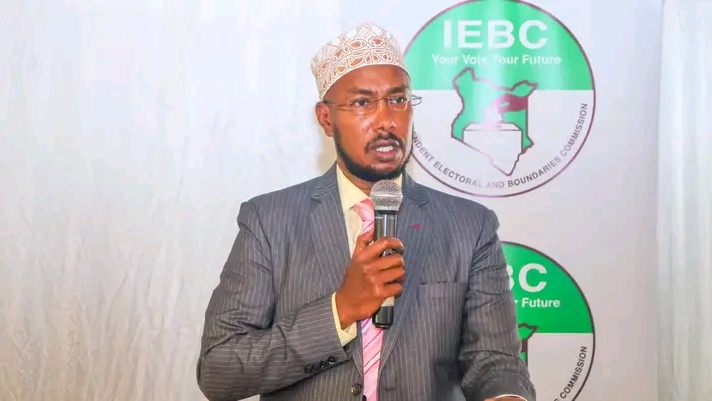
Breaking news: IEBC CEO Marjan Hussein Marjan resigns after nearly a decade at Anniversary Towers

0

In a major shake-up at Anniversary Towers, Marjan Hussein Marjan has officially resigned as Chief Executive Officer of the Independent Electoral and Boundaries Commission (IEBC), bringing to an end a nearly ten-year stint at the heart of Kenyaโ€™s electoral administration.

The commission confirmed Marjanโ€™s exit on the evening of Tuesday, February 3, 2026. His departure closes a chapter that began in April 2015, when he joined the IEBC as Deputy CEO before rising to the top job, overseeing some of the countryโ€™s most consequential and contested electoral cycles โ€” including the 2022 General Election and its aftermath.

In a farewell letter circulated to staff, Marjan framed his resignation as part of a โ€œmutually agreed-upon structured transitionโ€ within the Office of the Commission Secretary. While he stopped short of giving specific reasons for stepping down, he thanked the IEBC team for their professionalism and resilience, describing it as a privilege to have served the institution during a demanding period.

However, the exit comes against a backdrop of escalating political pressure. The IEBC has recently faced sustained criticism from opposition figures questioning its preparedness for the 2027 General Election. Just days before the resignation, opposition leaders staged a visit to the commissionโ€™s headquarters demanding sweeping reforms.

During that meeting, Democracy for Citizens Party (DCP) leader Rigathi Gachagua delivered a blunt assessment, publicly declaring that he had no confidence in Marjanโ€™s leadership and calling for new management to restore credibility and public trust in the electoral body.

In response to the sudden vacancy, the IEBC sought to calm public anxiety, insisting that institutional stability remains intact. In an official statement, the commission said the secretariat continues to be the backbone of electoral service delivery and must demonstrate readiness, integrity and commitment to conducting free and fair elections.

The IEBC added that an interim CEO will be appointed in due course to oversee day-to-day operations, including human resource management and the implementation of key policies. Attention now turns to who will take over the powerful role โ€” and whether a leadership reset at the top will ease political tensions as the countdown to the 2027 polls gathers pace.

IEBC CEO Marjan Hussein Marjan resigns after nearly a decade at Anniversary Towers

From stammer to sermon: how Rev. Lucy Natasha overcame childhood silence to lead a global ministry

0

Before commanding global platforms and filling auditoriums with her sermons, Lucy Natasha lived through nearly a decade of silence.

In a candid interview on the Daddy X Mo Podcast, the celebrated minister revealed a little-known chapter of her life: for the first nine years, she struggled with a severe stammer that made ordinary conversation an uphill battle.

The struggle was especially striking given her background. A third-generation preacher, raised by a mother and grandmother who were both ministers, Natasha appeared destined for the pulpit. Yet for a child โ€œborn into ministry,โ€ words refused to come easily, turning each sentence into a moment of fear and frustration.

A defining moment at age nine

The turning point came unexpectedly after a church conference. Visiting ministers had joined Natashaโ€™s family for dinner when they felt compelled to pray for the children of the house.

โ€œThey said God was saying there would be a prophet from this house,โ€ Natasha recalled.

Despite feeling like the least likely candidate because of her speech difficulty, the pastors singled her out, declaring, โ€œSheโ€™s the one.โ€ According to Natasha, what followed was immediate and unexplainable: her stammer disappeared, and her speech became fluent. The moment marked the end of years of silence and the beginning of a new path.

From mentorship to ministry

After the experience, Natashaโ€™s mother introduced her to structured mentorship, starting with childrenโ€™s crusades at Redeemed Gospel Church in Huruma. Still, ministry was not an automatic destination.

She attended Loreto Kiambu, where she was active in the Christian Union, before pursuing a diploma in Public Relations. At the time, she considered a career outside the church. โ€œBut if itโ€™s your calling, it will keep calling you,โ€ she said.

That call became unmistakable in 2017 during a tour of the United States. Natasha says she received a clear spiritual instruction that โ€œNairobi is the city of divine assignment.โ€ She returned home and launched Miracle Monday services at the 680 Hotel, attracting a diverse congregation and cutting across denominational lines.

Resistance in the city

Establishing a ministry in Nairobi came with resistance. As she prepared to plant a church in the city centre, Natasha says she received warnings and intimidation, including messages declaring, โ€œNairobi ina wenyeweโ€ โ€” Nairobi has its owners.

Despite the pressure, the services grew, eventually evolving into a full-fledged ministry with international reach.

โ€˜It was a processโ€™

Today, Rev. Natasha is keen to dispel the myth of overnight success. She insists that the public image many see is the result of years of discipline, mentorship and personal battles.

โ€œI didnโ€™t become a pastor in one day,โ€ she said. โ€œMany people who talk about Natasha today donโ€™t know the process. It has been a journey of so many years.โ€

From a childhood marked by silence to a ministry defined by voice and influence, her story stands as a testament to perseverance, faith and transformation.

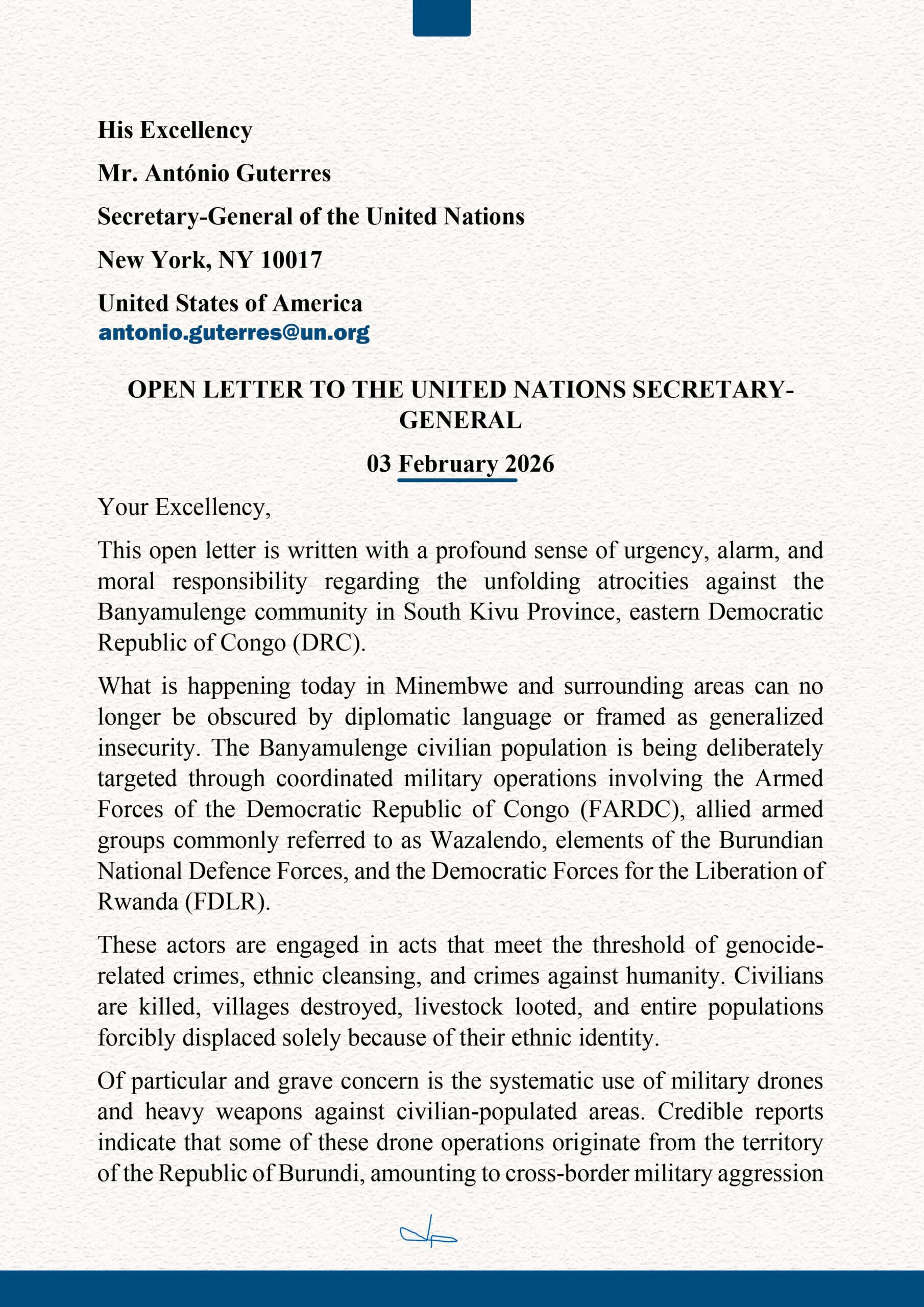
Banyamulenge community urges UN action over alleged genocide and drone attacks in South Kivu

0

The Banyamulenge community has issued an urgent open letter to United Nations Secretary-General Antรณnio Guterres, warning of what it describes as ongoing genocide-related crimes, ethnic cleansing, and state-sponsored violence in South Kivu Province, eastern Democratic Republic of Congo (DRC).

In the letter, Jean de Dieu Bizinde, CEO Officer and Ambassador of Peace of the Banyamulenge Community in Australia, accuses multiple armed actors of coordinating attacks against Banyamulenge civilians in Minembwe and surrounding areas. According to the letter, those allegedly involved include the Armed Forces of the Democratic Republic of Congo (FARDC), allied militias commonly known as Wazalendo, elements of the Burundian armed forces, and the Democratic Forces for the Liberation of Rwanda (FDLR).

โ€œThe violence unfolding on the ground can no longer be framed as generalized insecurity,โ€ the letter states, arguing that civilians are being targeted specifically because of their ethnic identity. Entire villages have reportedly been destroyed, livestock looted, and thousands of civilians forced to flee their homes.

Drone warfare and cross-border allegations

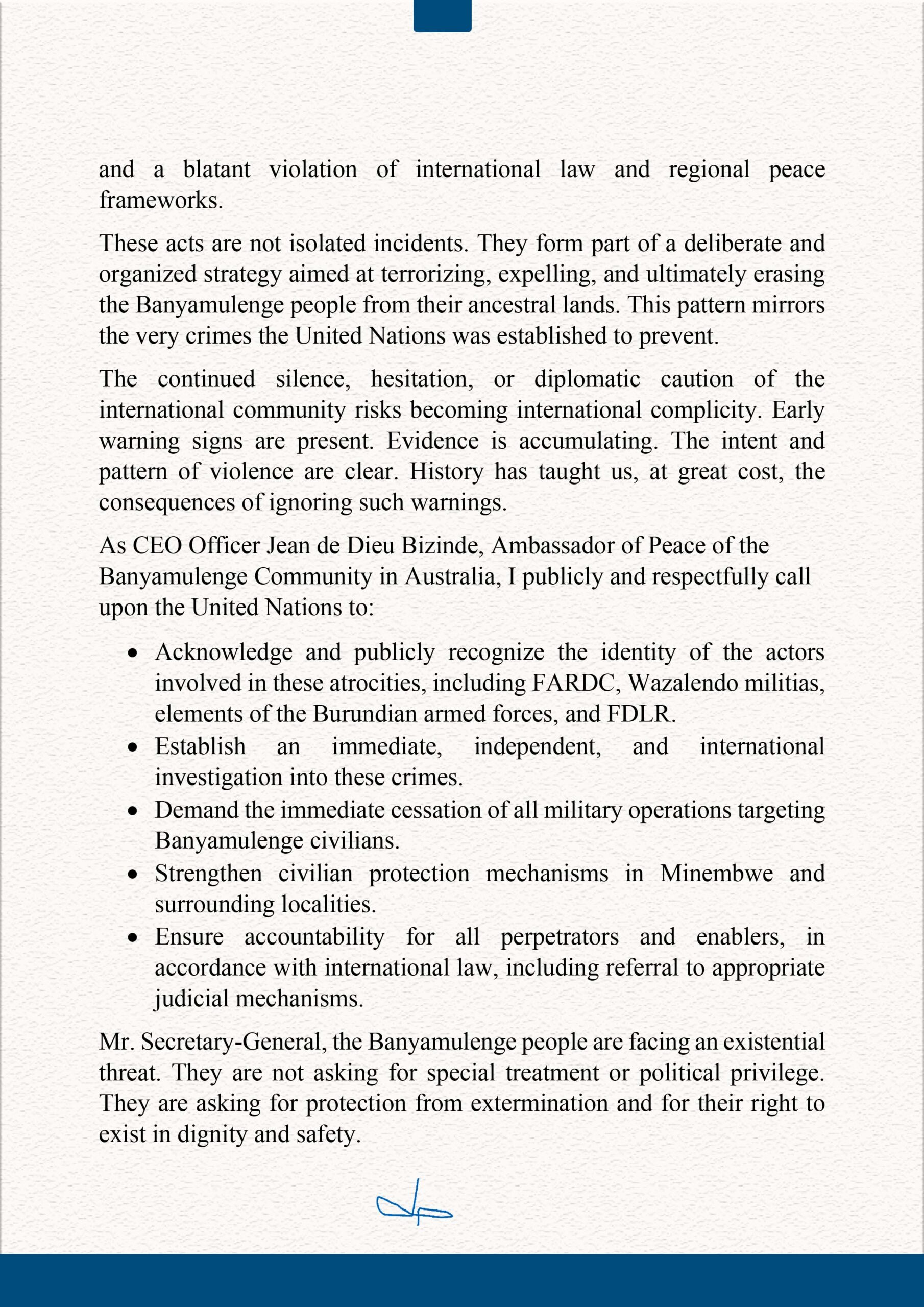
A central concern raised in the open letter is the alleged use of military drones and heavy weapons against civilian-populated areas. The Banyamulenge leadership claims that such attacks represent a dangerous escalation in the conflict and amount to collective punishment of a civilian population.

The letter further alleges that some drone operations originate from neighboring Burundi, a claim that, if substantiated, would point to cross-border military involvement and serious violations of international humanitarian law. The accusations call for an independent international investigation to establish responsibility and verify the chain of command behind the attacks.

Calls for accountability and international action

The Banyamulenge community argues that the pattern, scale, and consistency of the violence meet internationally recognized thresholds for crimes against humanity and genocide-related acts. The letter warns that continued inaction by the international community risks entrenching impunity and creating what it describes as โ€œinternational complicity through silence.โ€

Among the demands addressed to the United Nations are an immediate halt to military operations targeting civilians, the deployment of stronger civilian protection mechanisms in Minembwe and surrounding localities, and the initiation of an independent fact-finding mission. The letter also calls for accountability measures, including possible referrals to international judicial mechanisms.

Broader diplomatic outreach

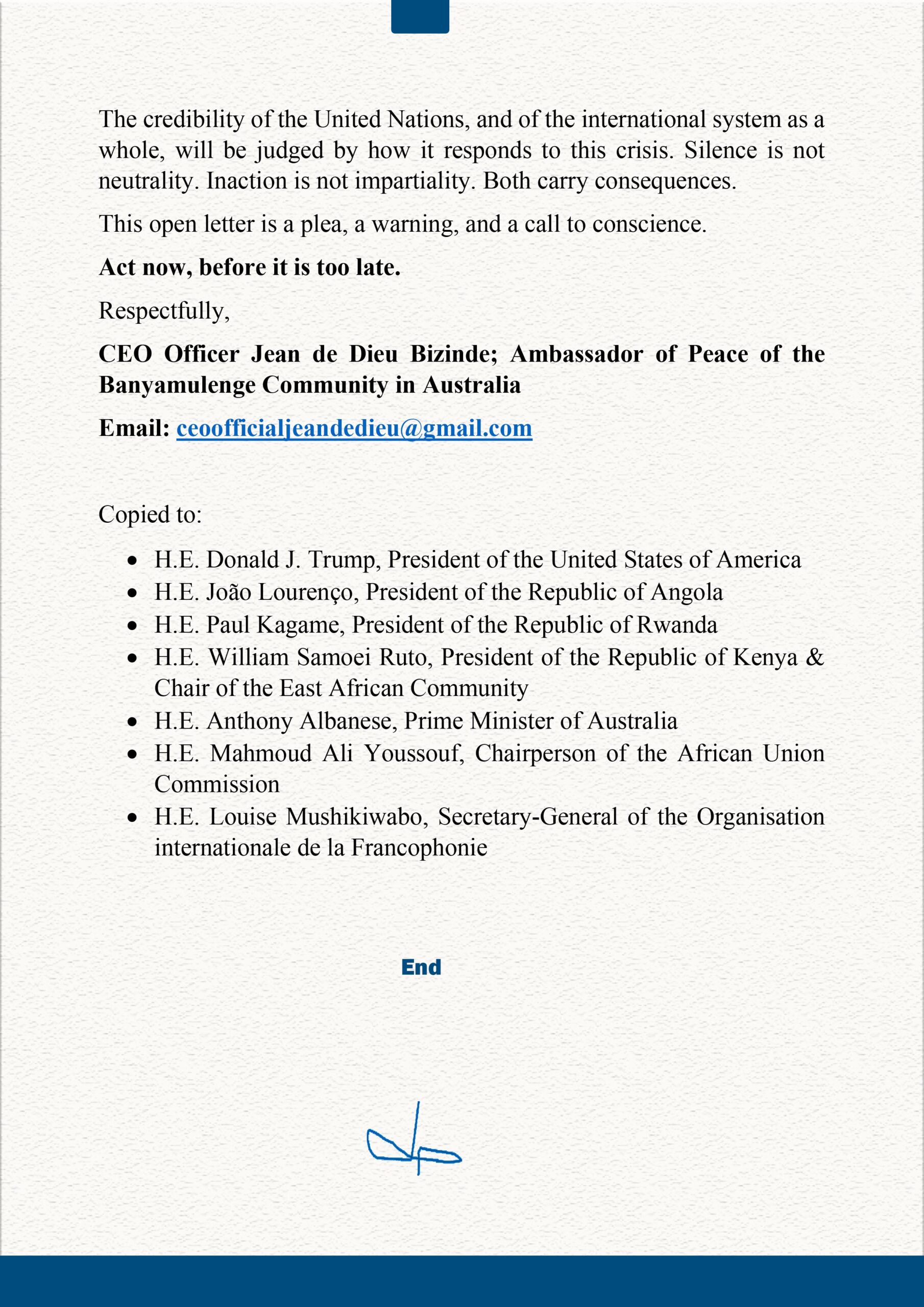
Copies of the open letter were sent to several international and regional leaders, including the President of the United States, the Chair of the African Union, the President of Angola, the President of Rwanda, the President of Burundi, the Chair of the East African Community, the Prime Minister of Australia, and the Secretary-General of the Organisation internationale de la Francophonie.

โ€œThe Banyamulenge people are facing an existential threat,โ€ Bizinde wrote. โ€œThey are not asking for political privilege, but for protection from extermination and the right to exist in dignity and safety.โ€

A test for international institutions

The letter concludes with a warning that the credibility of the United Nations and the broader international system will be judged by how it responds to the crisis in South Kivu. โ€œSilence is not neutrality,โ€ it says, urging decisive action to prevent further loss of civilian life.

As violence continues in eastern Congo, the appeal adds to growing calls from civil society groups and affected communities for stronger international engagement to protect civilians and address long-standing cycles of violence in the region.

Nairobi: Popular Umoja gym trainer killed in alleged KDF-linked altercation

0

Shock and grief have engulfed residents of Umoja estate in Nairobi following the death of Alphy Migasa, a well-known gym trainer whose killing has sparked outrage and sorrow within the community.

Migasa, widely admired by his clients for his professionalism, skill, and dedication to promoting healthy living, was reportedly attacked by a soldier from the Kenya Defence Forces (KDF). The assailant is said to have accused Migasa of having an intimate relationship with his wife.

According to accounts from people familiar with the incident, the soldier had recently returned from deployment in Somalia. Upon his return, he allegedly learned of claims that his wife was involved with Migasa. Witnesses say he tracked Migasa to a bar in Umoja, where a confrontation broke out and quickly escalated into a violent altercation.

Migasa sustained serious injuries during the fight and was rushed to hospital. Despite efforts by medical personnel, he succumbed to his injuries while undergoing treatment.

Videos circulating on social media show Migasa at work during ordinary training sessions, coaching clients through fitness routines. Friends and clients say the footage now serves as a painful reminder of a trainer with exceptional talent who helped many people improve their physical health and confidence.

His death has left clients and residents of Umoja deeply shaken. Many have described him as disciplined, approachable, and passionate about his work. Meanwhile, authorities have launched investigations into the incident as the community awaits further updates and justice in the case.

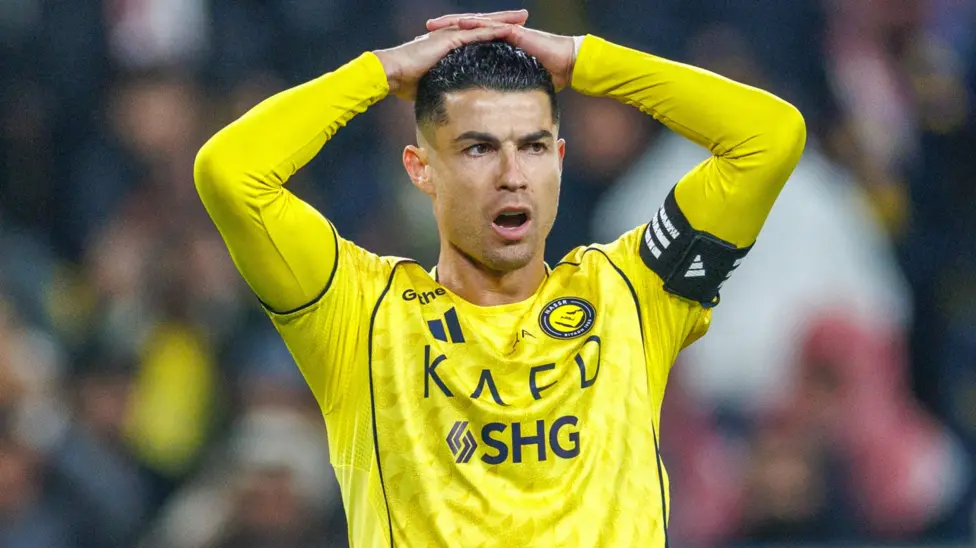
Ronaldoโ€™s future at Al-Nassr in doubt after squad omission

0

Cristiano Ronaldoโ€™s future at Al-Nassr has been thrown into uncertainty after the Portuguese forward was left out of the squad for Mondayโ€™s Saudi Pro League fixture against Al-Riyadh, fuelling fresh speculation about tensions behind the scenes.

Portuguese newspaper A Bola reported that the 40-year-old has grown increasingly dissatisfied with the clubโ€™s management under Saudi Arabiaโ€™s Public Investment Fund (PIF), which controls several top clubs in the kingdom, including Al-Hilal. Sources close to the situation said Ronaldo is frustrated by what he perceives as an imbalance in sporting ambition and investment.

Ronaldo joined Al-Nassr in December 2022 after leaving Manchester United, signing a contract that made him the highest-paid player in football history, reportedly earning around ยฃ177 million per year. Despite his prolific goal-scoring record, his only silverware with the club remains the Arab Club Champions Cup won in 2023. He signed a new two-year deal in June 2025, extending his stay until 2027.

The five-time Ballon dโ€™Or winner has continued to deliver on the pitch. He finished as the Saudi Pro Leagueโ€™s top scorer in each of the past two seasons and recently reached 961 career goals, edging closer to his stated target of 1,000. Yet team success has proved elusive. Al-Nassr finished runners-up in the league twice before dropping to third place last season, 13 points behind champions Al-Ittihad, and also lost the 2023-24 Kingโ€™s Cup final on penalties to Al-Hilal.

Ronaldoโ€™s frustrations have reportedly been compounded by the success of rival clubs. Al-Hilal, Al-Ittihad and Al-Ahli have all lifted major trophies since PIFโ€™s takeover of Saudi football in 2023, while Al-Nassr have fallen short in domestic and continental competitions, including elimination in the Asian Champions League Elite semi-finals last season.

Investment patterns have also shifted. While Saudi clubs spent heavily in 2023, new financial regulations introduced in mid-2025 have pushed teams toward a more restrained model. Al-Nassr, though still competitive, have reportedly lagged behind rivals and even newly promoted sides in transfer spending in recent windows, adding to perceptions that they are losing ground at the top.

For now, neither Ronaldo nor Al-Nassr have publicly commented on the reasons behind his omission. But his absence, coupled with reports of internal dissatisfaction, has reignited debate over whether one of footballโ€™s most decorated players will see out his contract in Riyadh โ€” or whether another high-profile chapter in his career is approaching a dramatic turning point.

Ronaldoโ€™s future at Al-Nassr in doubt after squad omission

Kenyan family seeks help to repatriate body of relative killed while fighting for Russia in Ukraine

0

A Kenyan family is appealing for answers and assistance to repatriate the body of a relative who was killed in Ukraine while fighting for Russia, amid growing concern over the recruitment of Africans into the war.

Clinton Nyapara Mogesa, 29, left Kenya in 2024 to take up work in Qatar, but later informed his family that he was heading to Russia. On Saturday, Ukrainian authorities said Mogesa died in what they described as a โ€œhuman waveโ€ assaultโ€”tactics in which Russia is accused of deploying large numbers of poorly trained recruits to overwhelm Ukrainian forces, often at heavy cost.

According to Ukrainian officials, Mogesa was killed in Donetsk, eastern Ukraine, after being recruited following his stint in Qatar. They said Russian forces did not recover his body and that he was found carrying travel documents belonging to two other Kenyan nationals.

His death comes as anxiety mounts in Kenya over reports that citizens are being lured abroad with promises of well-paid jobs, only to be coerced into military service in Russia. Vincent Okemwa, Mogesaโ€™s cousin, said the family initially struggled to accept the news. He told Afrovera Newsday that the first information came through a colleague who had a relative working in Russia, before the reports became public.

Okemwa said Mogesa had informed the family when he moved from Qatar to Russia and that they remained in contact while he underwent three weeks of training. Communication later stopped, with the last contact dated October 28, 2025. โ€œAfter that, we heard nothing,โ€ he said.

The family is now โ€œin deep distress,โ€ Okemwa added. He said Mogesaโ€™s father had sold land to finance his sonโ€™s travel to Qatar, and the young man was seen as the familyโ€™s main hope for a better future. โ€œI donโ€™t know how to explain it, but things are not well,โ€ he said. โ€œHe had good plans for the family, and now everything has collapsed.โ€

Joel Mogere, another relative, told Citizen TV in Kenya that Mogesaโ€™s death had shaken the family, describing him as the breadwinner and the foundation of their livelihood. His mother, Mellen Moraa, who suffers from diabetes, said her son used to buy her medication and care for her. โ€œI am asking the government to help me,โ€ she said.

Last month, the Kenyan government said 18 nationals who had been fighting in Russia were rescued and repatriated. However, the authorities have not confirmed any deaths of Kenyan citizens in Ukraine. In November 2025, Kenyaโ€™s foreign affairs minister said nearly 200 Kenyans were known to be fighting for Russia, warning that recruitment efforts were continuing.

Human rights group Vocal Africa said last week it was tracking cases of at least 18 Kenyans believed to have died or gone missing, adding that the true number could be higher. Similar warnings have been issued across Africa, where young people are reportedly being targeted with promises of lucrative employment in Russia, only to end up conscripted.

Ukrainian intelligence estimates that more than 1,400 people from 36 African countries have been recruited to fight for Russia. Ukraine has previously faced criticism for attempting to recruit foreign fighters as well, but has repeatedly warned that anyone fighting for Russia will be treated as an enemy combatant unless they surrender.

On Saturday, Ukrainian intelligence again cautioned foreign nationals against travelling to Russia or accepting job offers there, particularly informal or illegal work, saying such moves carry โ€œreal risks of forced deployment to frontline units with minimal training and slim chances of survival.โ€